

Guide
Agency fees and how long a sale takes in Luxembourg
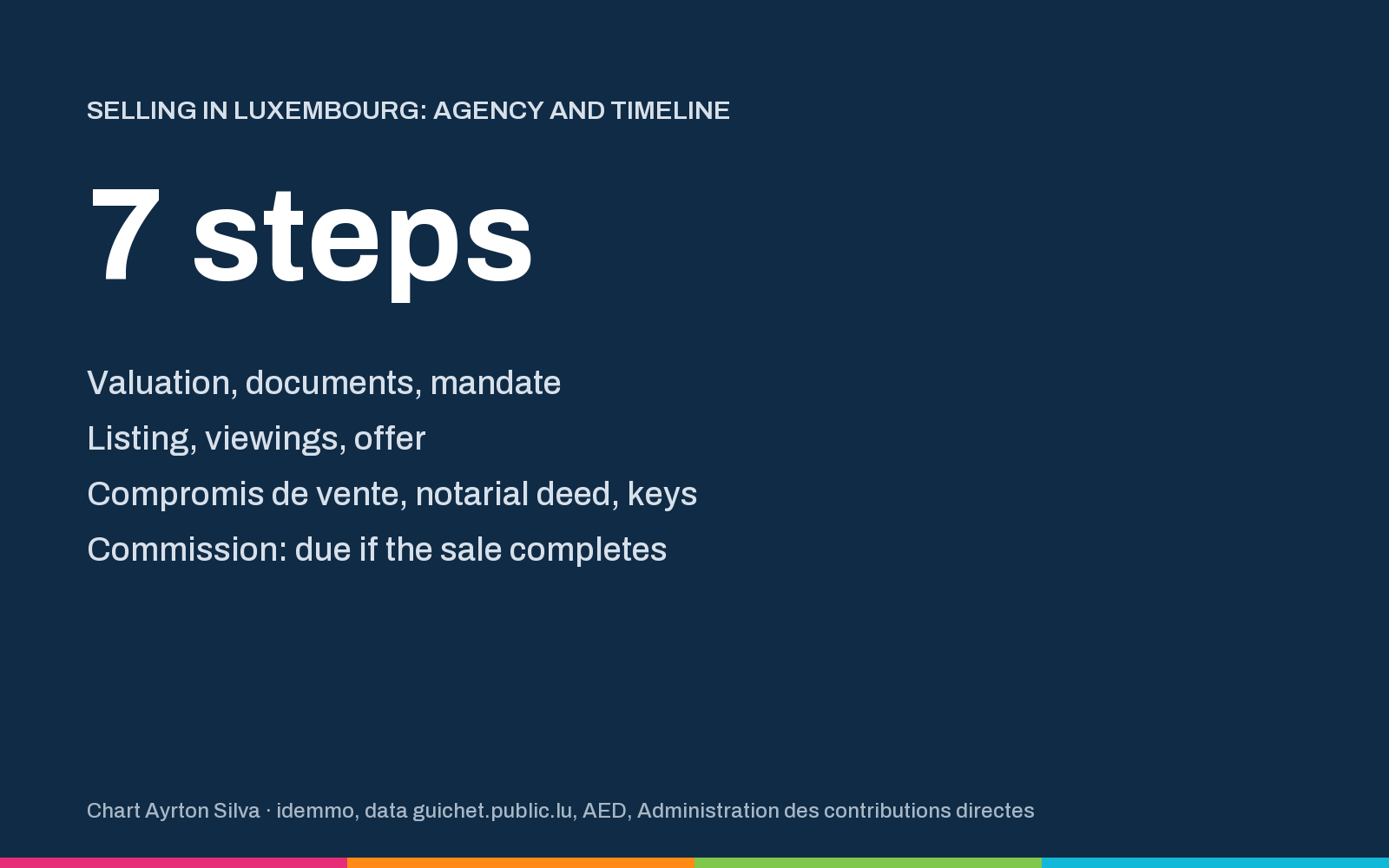
In Luxembourg, an agency is paid a commission that is due only if the sale completes. It is set in the written mandate, borne by the party who instructed the agent, usually the seller, and is normally settled at the notarial deed. A sale runs through seven steps, from the valuation to the handover of keys; how long it takes depends mainly on the asking price, the file and the buyer's loan.
How is an agency paid, and by whom?
An estate agency is paid a commission on the sale. That commission pays for a result: it is due only if the sale completes. No sale, no commission. Check that your mandate says so in those terms.
The commission is borne by the party who instructed the agent, so usually the seller.1 The compromis de vente often records who covers the notary's costs and, where there is one, the agent's.1
VAT is added to the agreed amount.1 The standard VAT rate in Luxembourg is 17 %.2 Always ask for the amount including all taxes: that is what will come off your sale price.
What the mandate sets
Everything is decided in the written mandate, signed before the first listing. Nothing is discussed again once the buyer is found. A complete mandate sets six points:
- Who pays the commission: the seller, the buyer, or both under a written split.
- The base: the sale price actually signed, not the price first advertised.
- When it falls due: the mandate normally ties the commission to the signing of the notarial deed, when the price is paid.
- Exclusivity: a non-exclusive mandate, which leaves you free to sell yourself or through another agency, or an exclusive mandate, which reserves the sale for one agency.
- The term: a written end date, and the conditions of any renewal.
- The ending: how each party brings it to an end, in what form and with what notice.
The mandate is an intermediary's instrument: it is registered within ten days of its date.3
Before signing, check
- The asking price, and the recorded sales that support it.
- The amount of the commission, all taxes included, and the base it is calculated on.
- What happens if you find a buyer yourself.
- What happens if the sale falls through after the compromis, for example on a loan refusal.
- The end date of the mandate and how to bring it to an end.
- What the agency undertakes to do: written valuation, photographs, listing, viewings, checking the buyers' financing.
Why this site shows no rate
The amount of the commission is agreed case by case, according to the property and the work entrusted, and it is written in the mandate. A general rate would say nothing about your property, so this site shows none. The discussion starts with a defensible price, not with a percentage.
The other costs of a sale: who pays what
| Item | Who pays |
|---|---|
| Registration and transcription duties | The buyer |
| Notary's costs | The buyer, by established practice |
| Agency commission | The party who instructed the agent |
| Energy performance certificate (CPE) | Whoever orders it, so the seller |
| Tax on the capital gain | The seller, depending on their situation |
Registration and transcription duties come to 7 % in total: 6 % registration and 1 % transcription.1 The parties remain free to split the notary's costs differently, but practice leaves them with the buyer; the party who pays them generally chooses the notary.1 The person who orders a CPE pays for it.4
That leaves tax. The gain made on the seller's main residence is not taxable.6 For another property, a resale less than five years after the acquisition is a speculative gain, taxed at the ordinary rate; beyond five years it is a disposal gain, taxed at half the overall rate, 21 % at most, after an allowance of 50 000 € over ten years, 100 000 € for spouses or partners taxed jointly.5 The article on capital gains details the calculation, and the net proceeds tool sets out the items one by one.
How long does a sale take? The seven steps
The public series used on this site cover prices, not selling times, so this guide quotes no average duration. It gives a period only where an official source gives one.
- Valuation and documents. The price is set on recorded sales and the papers are gathered: title deed, CPE, co-ownership file. The CPE, valid for 10 years, must exist before the listing.4 The full list is in the article on the documents needed to sell.
- Mandate. It sets the asking price, the commission and the term of the assignment, and is then registered within ten days.3
- Marketing and viewings. Photographs, listing, viewings. This is the step whose length varies most: it depends first on the gap between the asking price and the prices recorded in the commune, shown in the ranking of communes by price per m².
- Offer. The buyer proposes a price and conditions. The seller checks the financing before accepting: see the article on the purchase offer.
- Compromis de vente. Once signed by both parties, it is final.1 It usually contains conditions precedent, including the loan condition. It is presented for registration within 3 months; with a condition precedent, the registration cost is fixed, 12 euros.1
- Notarial deed. The notary checks that the seller owns the property and searches for mortgages, easements and other charges, then draws up the deed, which makes the sale enforceable against third parties.1 The price is paid; the commission normally falls due.
- Handover of keys. It takes place when the deed is signed or on the date agreed between the parties, with the meter readings.
| Step | What happens | What can slow it |
|---|---|---|
| Valuation and documents | Price set, papers gathered | A CPE to order, a title deed to find, a slow managing agent |
| Mandate | Signature and registration | A disagreement between co-sellers, the spouse's consent |
| Marketing and viewings | Listing and viewings | An asking price above recorded sales, a property that is hard to view |
| Offer | Price and conditions proposed | Financing not checked, a drawn-out negotiation |
| Compromis de vente | Both parties committed | A condition precedent with no date, a missing document |
| Notarial deed | Notary's checks, signature, payment | A mortgage to release, a loan granted late |
| Handover of keys | Keys and meter readings | A property still occupied |
If the buyer's loan is refused
With the loan condition, the buyer is only obliged to buy after receiving the loan; until it is obtained, the effects of the compromis remain suspended.1 The parties are free to set the period within which the buyer tells the seller of the bank's agreement or refusal. The periods seen in practice are at least 4 to 6 weeks, and an official letter from the bank can extend them.1 In a dispute, it is for the buyer to prove that a loan was applied for in time, with at least one bank.
Another case: the party who withdraws without being entitled to owes the indemnity set by the penalty clause. In practice, that indemnity is set at 10 % of the sale price.1 The detail is in the article on the compromis and the acte notarié.
What speeds up a sale
- A complete file before the listing: CPE, title deed, co-ownership papers.
- An asking price based on recorded sales, not on listings.
- Financing checked at the offer stage.
- A condition precedent written with its deadline.
- A notary instructed at the compromis, with the details of any loan still running on the property.
None of these points promises a duration. They remove the causes of delay that the seller controls.
Before signing a mandate, a written valuation sets a defensible price, figure by figure. Request yours.
Sources
- Connaître le contenu et la valeur juridique d'un compromis de vente · guichet.public.lu · 18/11/2026
- Taux de TVA · Administration de l'enregistrement, des domaines et de la TVA (AED) · 18/11/2026
- Loi modifiée du 28/01/1948 sur la perception des droits d'enregistrement · Legilux, loi modifiée du 28/01/1948 · 29/10/2026
- Faire établir un certificat de performance énergétique (Energiepass) pour un bâtiment d'habitation · guichet.public.lu · 18/11/2026
- Vente d'un immeuble bâti ou non bâti · Administration des contributions directes (impotsdirects.public.lu) · 18/11/2026
- Déclarer la vente ou l'échange d'un bien immobilier · guichet.public.lu · 18/11/2026
Every figure in the article points to a public source, cited with its date. Sources are in French.
Frequently asked questions
Who pays the estate agency when a property is sold in Luxembourg?
The commission is borne by the party who instructed the agent, so usually the seller. The mandate states it, and the compromis de vente often records who covers the notary's costs and the agent's.
When is the agency commission due?
Only if the sale completes. The mandate sets the moment it falls due; it normally ties it to the signing of the notarial deed, when the price is paid. Read that clause before signing.
Can I sell the property myself during an exclusive mandate?
It depends on the exclusivity clause. A non-exclusive mandate leaves you free to sell yourself. An exclusive mandate reserves the sale for one agency for its term; depending on its wording, the commission may remain due even if you find the buyer.
What happens if the buyer's loan is refused?
If the compromis contains the loan condition, the buyer is only obliged to buy after obtaining the loan. The buyer must tell the seller of the bank's agreement or refusal within the period written in the compromis; in practice that period is at least 4 to 6 weeks.
How long between the compromis and the notarial deed?
The official sources consulted give no duration. The parties write the deadline for the deed into the compromis. Two markers are sourced: the loan period, at least 4 to 6 weeks in practice, and the registration of the compromis, within 3 months.
Request my written valuation
Property address, commune, a word about your plans: Ayrton calls you back.
Prefer a message? One word is enough.
Send ESTIMATION on WhatsAppRead next
Selling and buying again in Luxembourg: which comes first?
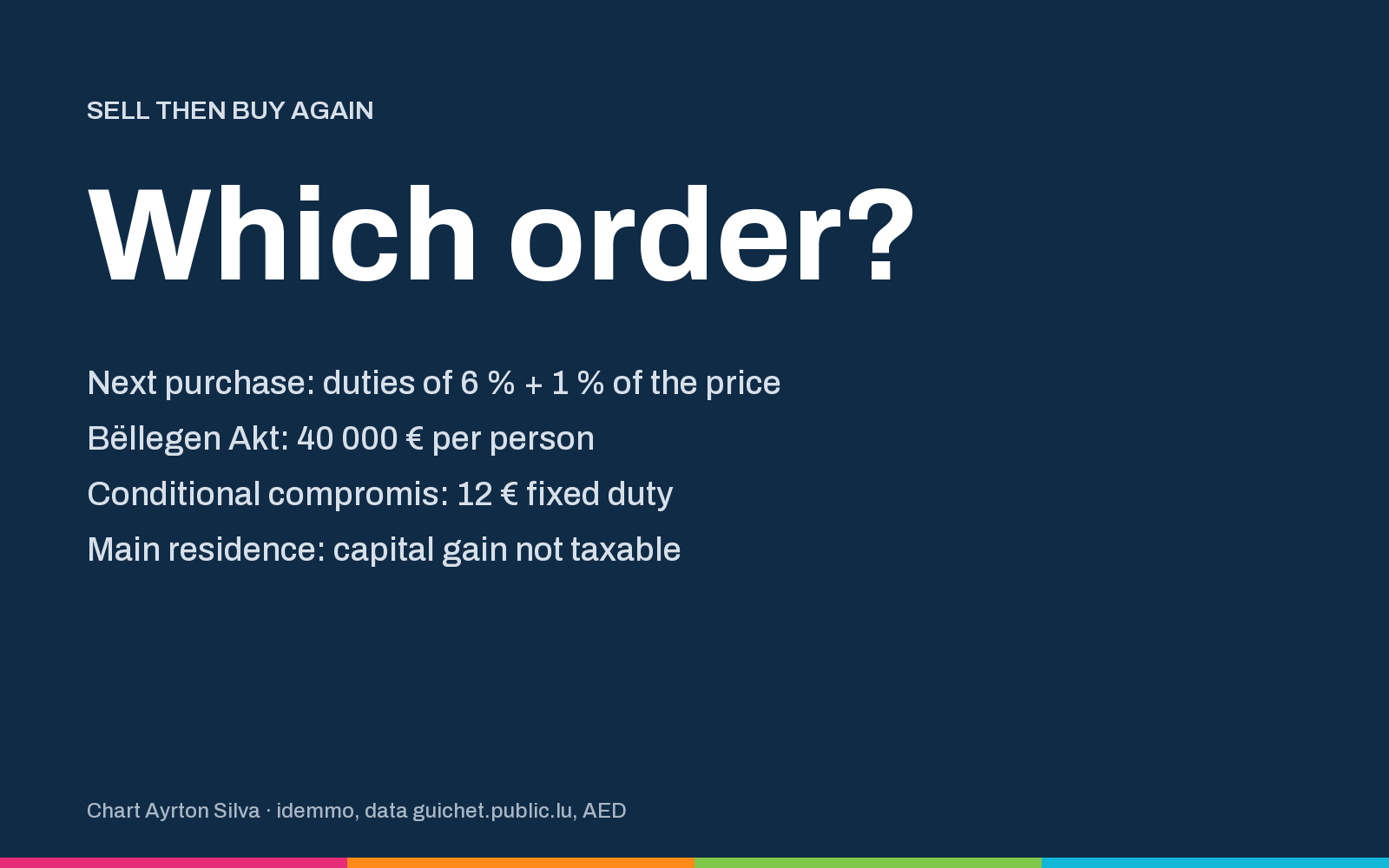
Selling first fixes your budget but may mean a temporary home; buying first secures your next home but needs transition financing. Either way, the next purchase carries duties of 6 % and 1 % of the price, reduced by the Bëllegen Akt of 40 000 € per person if credit remains, and the capital gain on your main residence is not taxable if the deadlines are met.
Selling a home during a separation or divorce in Luxembourg
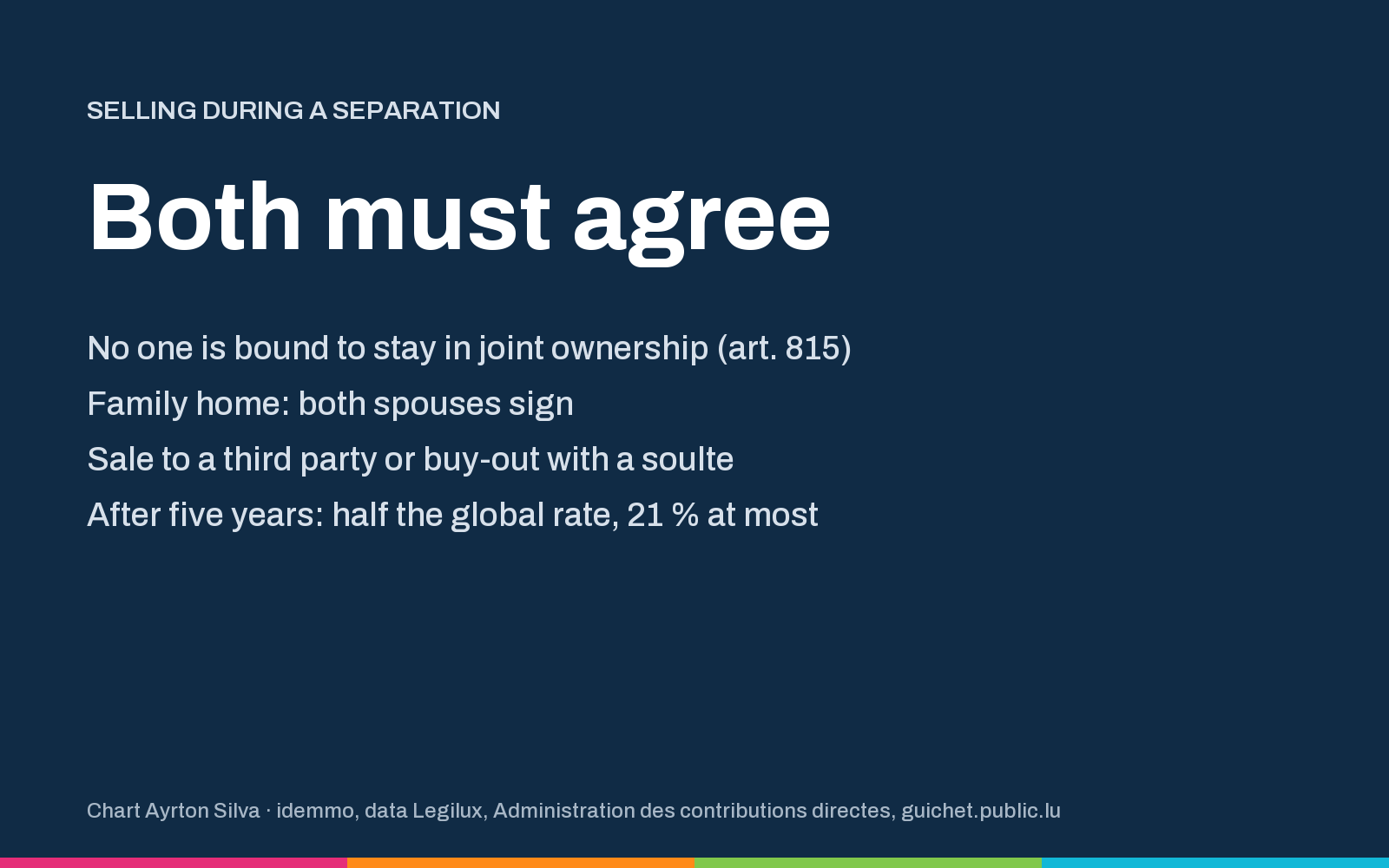
In Luxembourg, a property owned by two people is sold with the agreement of both owners, and the family home of a married couple cannot be sold without both spouses signing. By agreement, there are two routes: sell to a third party and share the price, or let one buy out the other's share against a soulte, by notarial deed. No one is bound to stay in joint ownership, and without agreement a division is requested in court, where a sale by auction is possible. Capital gains follow the usual rules: main residence exempt under conditions, including for the one who left if the sale takes place by 31 December of the year after the move, half the global rate beyond five years, 21 % at most.
Selling a rented property in Luxembourg: the tenant's lease
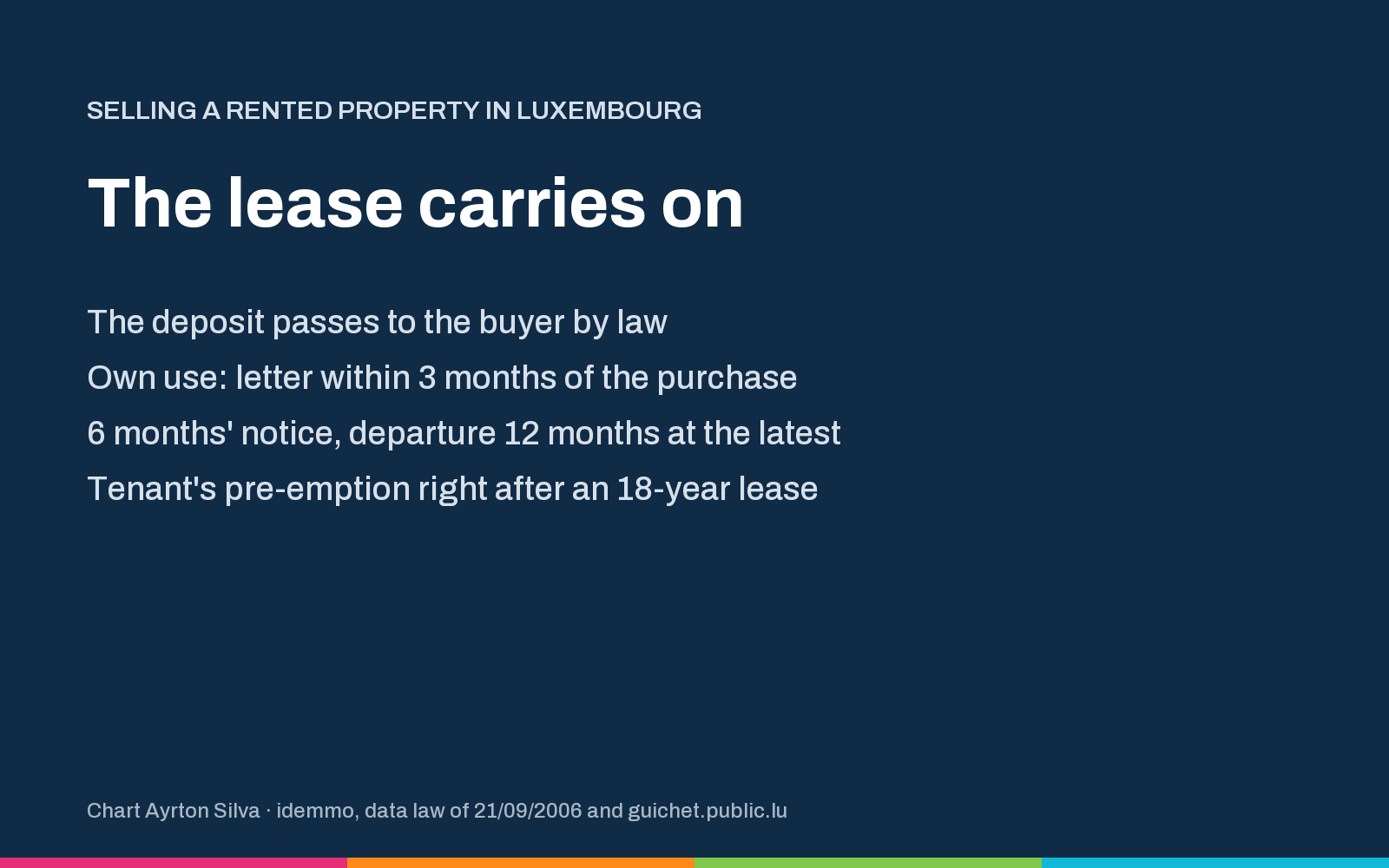
In Luxembourg, selling a rented home does not end the lease: it carries on with the buyer, and the sale is not a serious ground for making the tenant leave. The deposit passes to the new owner by law. A buyer who wants to live in the home sends a termination letter within 3 months of the purchase, with a notice period of 6 months, and the tenant leaves 12 months after the letter at the latest. After an 18-year lease, the tenant may hold a pre-emption right.