

Guide
Selling and buying again in Luxembourg: which comes first?
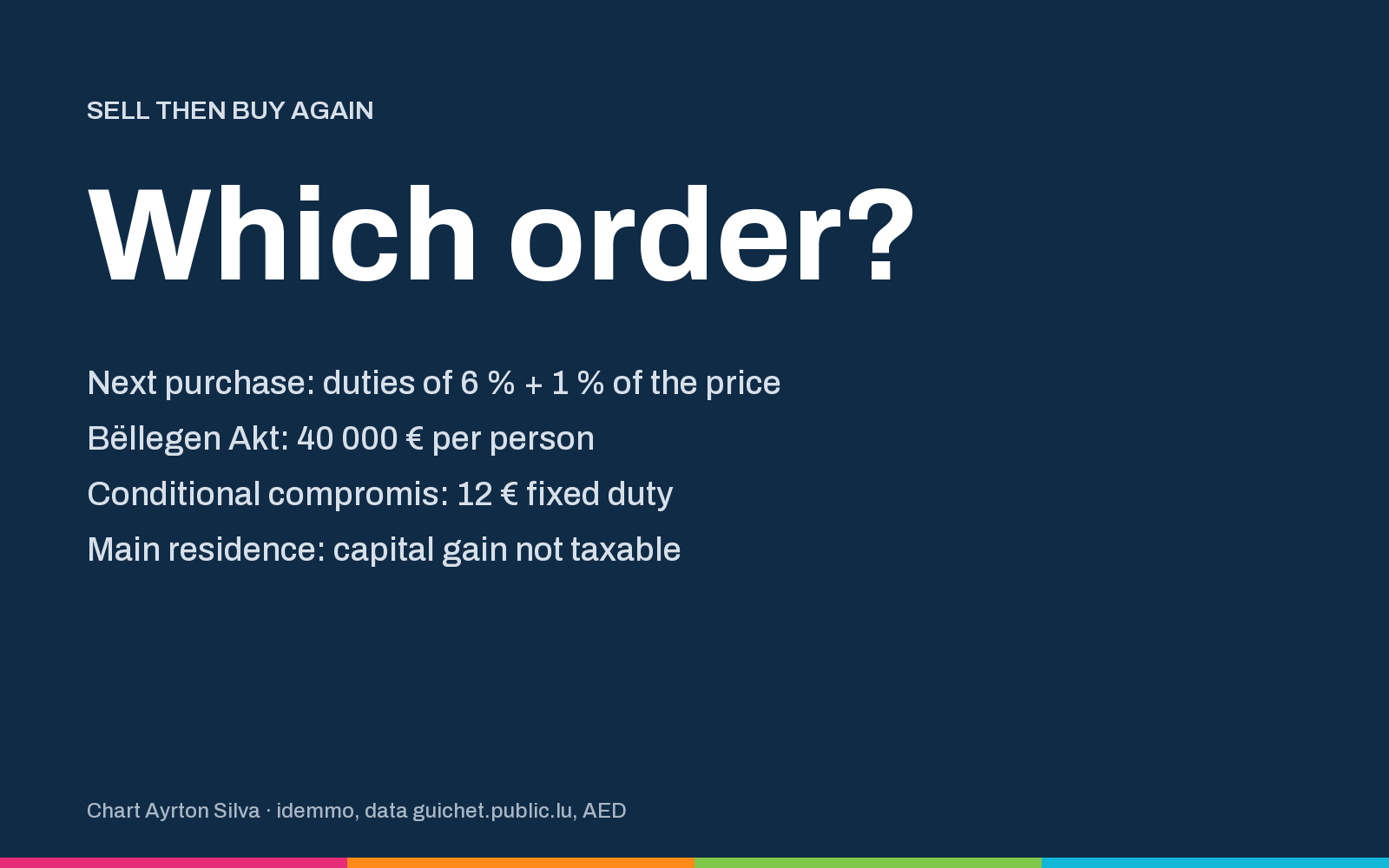
Selling first fixes your budget but may mean a temporary home; buying first secures your next home but needs transition financing. Either way, the next purchase carries duties of 6 % and 1 % of the price, reduced by the Bëllegen Akt of 40 000 € per person if credit remains, and the capital gain on your main residence is not taxable if the deadlines are met.
The short answer
Selling first means knowing your budget before you buy. Buying first means holding your next home before letting go of the current one. Both orders can be defended; what decides between them is your financial margin, how long you can carry two properties and how precisely your sale price is estimated.
Whichever order you choose, four official rules apply: the duties on the next purchase, the Bëllegen Akt, the registration of the compromis and the capital gains exemption on the main residence. This guide sets them side by side to help you choose.
Scenario 1: sell first
You sign the compromis de vente for your home, then look for or sign your next purchase.
What you gain. The sale price is fixed in writing. Your purchase budget rests on a known amount, and your bank finances the next property on that basis. No double repayments, no pressure to lower your price because the next purchase is already signed.
What it takes. Sometimes a temporary home between the deed of sale and moving into the next property. This gap is negotiable: the date of the deed is set in the compromis, and you can ask for a deed date far enough away to find and sign your purchase. Your buyer has their own constraints, usually obtaining their loan: the matching condition precedent appears in the compromis.
Scenario 2: buy first
You sign the compromis for your next home before selling the current one.
What you gain. The property you want is secured. You move only once, and you sell an empty home, which is easier to show.
What it takes. Transition financing, since the sale proceeds are not yet available. This is the principle of the bridging loan: the bank advances part of the expected sale price for a limited period, and the loan is repaid when the sale goes through. Amount, term and cost are set by each bank, based on the value it retains for your property: ask for a written offer and compare it before signing anything. The main risk is simple to name: if the sale takes longer or closes at a lower price than planned, your margin shrinks.
There is a safeguard: writing into the purchase compromis a condition precedent linked to the sale of your current home, with a deadline. The seller of the property you are buying does not have to accept it; it is a negotiating point that affects the strength of your offer.
The two scenarios side by side
| Point | Sell first | Buy first |
|---|---|---|
| Budget for the next purchase | Based on a signed sale price | Based on an estimated sale price |
| Financing | Standard loan on the next property | Bridging loan until the sale |
| Main risk | Temporary home between two deeds | Sale slower or lower than planned |
| Useful condition precedent | Your buyer's loan, in your sale compromis | Sale of your home, in your purchase compromis |
| Negotiating position | Seller under no time pressure | Buyer with no condition, or one the seller must accept |
| Main-residence capital gain | Not taxable if you live there at the sale | Not taxable if the sale happens within the deadline after moving |
This table puts no figures on anything: the amounts depend on your price, your loan and your bank's offer.
The two compromis and the timeline
When you sell and buy again, you sign two compromis, one as seller and one as buyer. Each is registered within three months of its date; after that, the double duty applies.3 As long as a condition precedent is not met, registration costs a fixed duty of 12 €; the proportional duty becomes payable when it is met.4
The law sets no single deadline between the compromis and the notarial deed: the compromis sets the date of the deed and the deadline of each condition. In a two-step project, these dates are built together:
- The deadline of your buyer's loan condition should fall before that of your own sale condition, if you have one.
- The deed of sale comes before the deed of purchase, or on the same day, if you are counting on the sale proceeds.
- A margin between the two dates absorbs a delay from a bank or an administrative document.
Your notary and the other party's notary coordinate these dates; it is up to you to set them out clearly in each compromis.
A signed compromis counts as a sale: in principle you cannot withdraw from it, and the penalty clause owed by a party who withdraws without the right to do so is in practice set at 10 % of the sale price.6 Signing a purchase with no condition linked to your sale therefore commits you whatever happens to your current home.
What the next purchase will cost
Your next purchase carries registration duties of 6 % of the acquisition price and a transcription duty of 1 %.2 If it is your future home, the Bëllegen Akt is deducted: 40 000 € per person buying.2 After the credit is applied, the duty collected does not fall below 100 €.2
An important point for a second purchase: the credit is used up over successive acquisitions. If the duties on one purchase did not exhaust the credit, the balance can be used for other acquisitions until it runs out.1 What you already used for your current home must therefore be deducted: have your notary check the balance left for each buyer before you build your financing plan. The purchase costs tool applies these duties and the credit to a given price, as an example.
Two conditions of the credit matter here. You must live in the new home within two years of the deed, or within four years for land or a property under construction, then without interruption for at least two years.2 And if your current home itself benefited from the credit, selling it, renting it, even in part, or moving out before two years of occupation means repaying it in full, with interest.2 A recent owner should check this date before signing a compromis de vente. The credit is explained in detail in our article on the Bëllegen Akt.
The capital gain on your main residence
The capital gain made on the seller's main home is not taxable.5 In the sell-first scenario, you live in the home at the time of the sale: the condition is easy to meet.
In the buy-first scenario, you may have moved out before selling. The home is still treated as your main residence if the sale takes place by 31 December of the year after the move, with one of the conditions set: having lived there after buying it, having lived there for the 5 years before the sale, or a family or professional reason.5 Beyond that date, the home only remains your main residence if three conditions are all met, including not owning another home at your immediate disposal.5 If you already live in the property you bought, that route is in principle closed: set your sale deadline before you move. Exempt or not, the sale must always be declared.5
A property that is not your main residence, a rented flat or a second home, follows other rules, set out in our article on capital gains on property.
Estimate before signing the purchase
In both scenarios, one figure drives everything else: the price at which your current home can sell. If you buy first, your bridging loan and your margin rest on it. If you sell first, it sets your search budget.
An estimate that is too high is the classic trap of buying first: it leads you to sign a purchase the sale will not finance. An estimate that is too low makes you give up on a property within reach. Before signing a purchase compromis, get a written valuation based on the recorded sales in your commune, and set it against the budget your bank accepts.
Before you choose: the checklist
- Have your home valued in writing, before any purchase offer.
- Ask your bank what it will finance in each scenario, and on what conditions.
- Check each buyer's Bëllegen Akt balance and the occupation date of your current home.
- Plan the conditions precedent and their deadlines in each compromis.
- Put the deed of sale and the deed of purchase in the right order, with a margin.
- If you move before selling, note the deadline that protects the capital gains exemption.
Selling and buying again turns on the first figure you set. Ask for your valuation before signing the next purchase.
Sources
- Crédit d'impôt sur les actes notariés (« Bëllegen Akt ») · guichet.public.lu · 15/11/2026
- Crédit d'impôt sur les actes notariés (Bëllegen Akt) · Administration de l'enregistrement, des domaines et de la TVA (AED), pfi.public.lu · 15/11/2026
- Enregistrement : questions fréquentes · Administration de l'enregistrement, des domaines et de la TVA (AED) · 15/11/2026
- Guide des mesures logement de l'AED · Administration de l'enregistrement, des domaines et de la TVA (AED) · 15/11/2026
- Plus-value sur la vente de l'habitation principale · guichet.public.lu · 15/11/2026
- Connaître le contenu et la valeur juridique d'un compromis de vente · guichet.public.lu · 15/11/2026
Every figure in the article points to a public source, cited with its date. Sources are in French.
Frequently asked questions
Is it better to sell or to buy first in Luxembourg?
There is no single rule. Selling first fixes your budget and avoids carrying two properties; buying first secures your next home but requires transition financing and a well-estimated sale price. The choice depends on your financial margin and how long you can hold out.
Can I buy on condition that my current home sells?
Yes, if the seller of the property you are buying accepts it: it is a condition precedent to negotiate and write into the compromis, with a deadline. Without it, the purchase compromis binds you even if your sale falls through. Until it is met, the compromis is registered at the fixed duty of 12 €.
Am I still entitled to the Bëllegen Akt for my next purchase?
The credit is 40 000 € per person. If it was not fully used on an earlier purchase, the balance can be used for other acquisitions until it runs out. Your notary checks the balance available.
Is the sale of my main residence taxed if I have already moved out?
The capital gain on the main home is not taxable. If you left the home before selling it, the sale must take place by 31 December of the year after the move, with one of the conditions set by the administration. Exempt or not, the sale must still be declared.
Request my written valuation
Property address, commune, a word about your plans: Ayrton calls you back.
Prefer a message? One word is enough.
Send ESTIMATION on WhatsAppRead next
Purchase offer in Luxembourg: what the seller checks
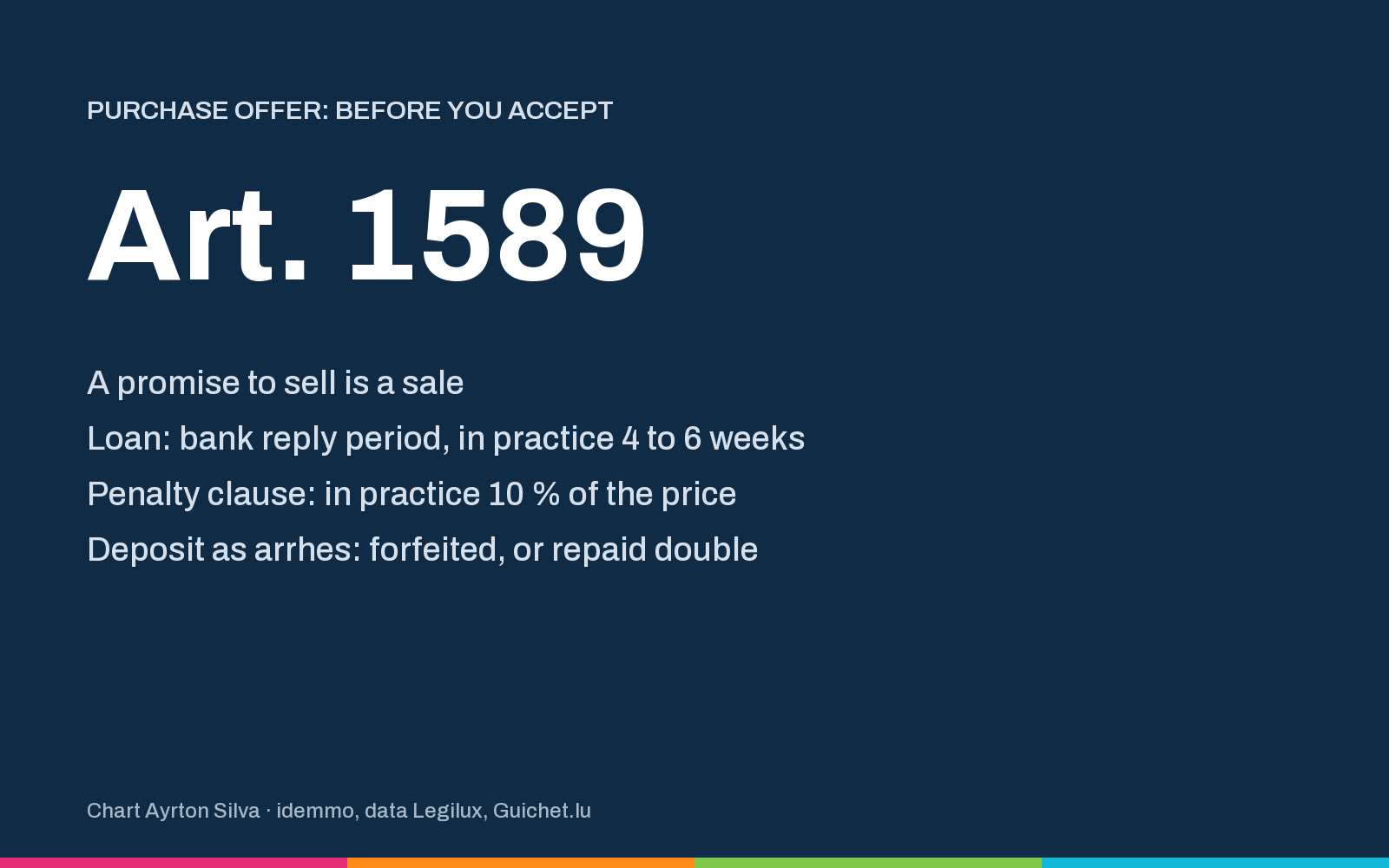
In Luxembourg, a sale is complete as soon as seller and buyer agree on the property and on the price (Civil Code, art. 1583). Accepting an offer in writing can therefore already bind you. Before signing, read the loan condition and its deadline, the nature of any sum paid and the planned date of the deed.
Documents to sell a property in Luxembourg: the checklist
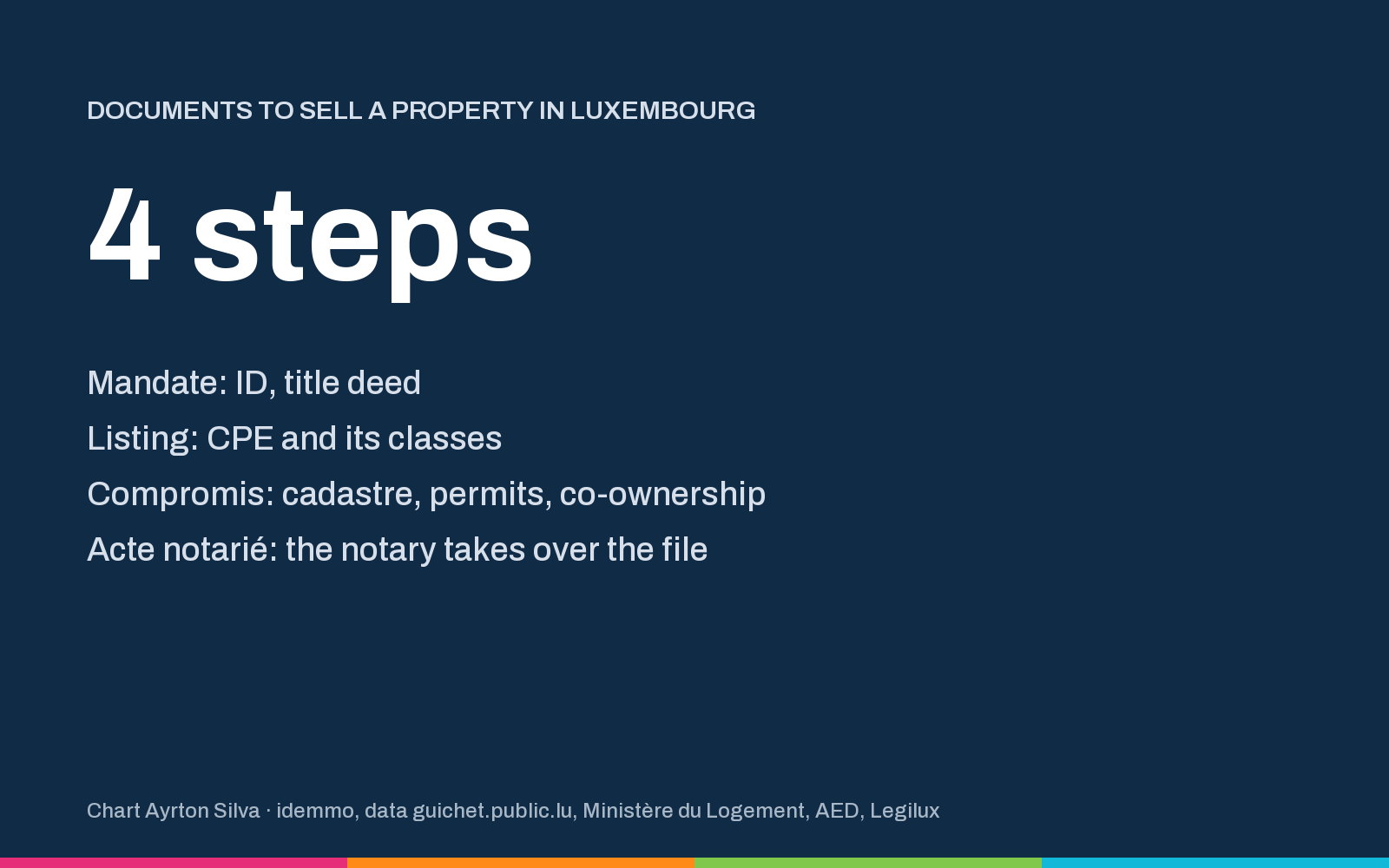
A sale in Luxembourg runs through four steps: the mandate, the listing, the compromis de vente and the acte notarié. The CPE, valid for 10 years, must exist before the listing, which shows its classes. The title deed, the cadastral extract, the building permits and, in a co-ownership, the tableau descriptif de division and the balance of the works fund are gathered before the compromis.
From compromis de vente to acte notarié: deadlines and costs
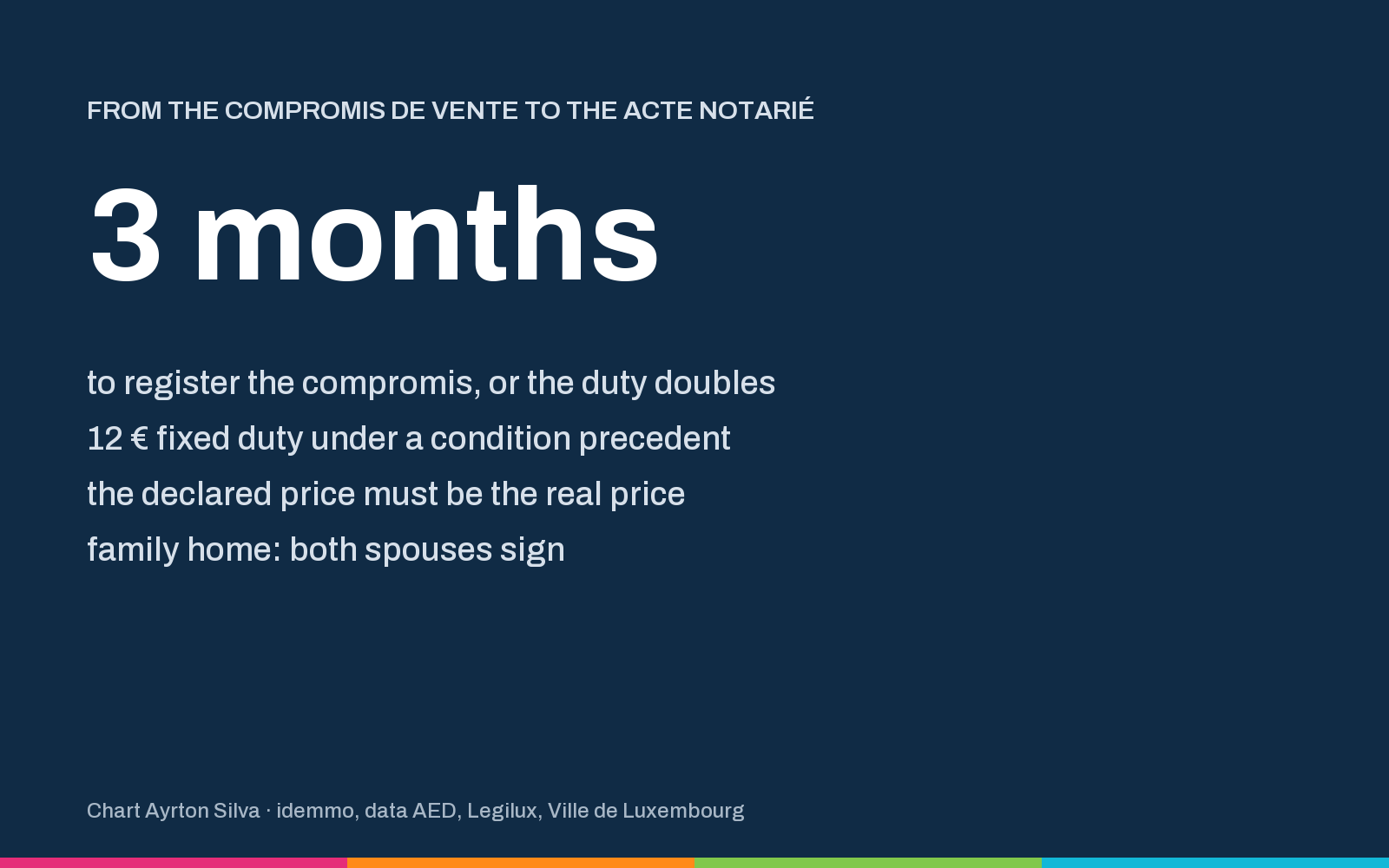
In Luxembourg, a private compromis de vente must be registered within three months, otherwise the double duty applies. While the condition precedent is not met, only a fixed duty of 12 € is due. The declared price must be the real price, and the family home can only be sold with both spouses' consent.
Luxembourg