

Guide
Selling a home during a separation or divorce in Luxembourg
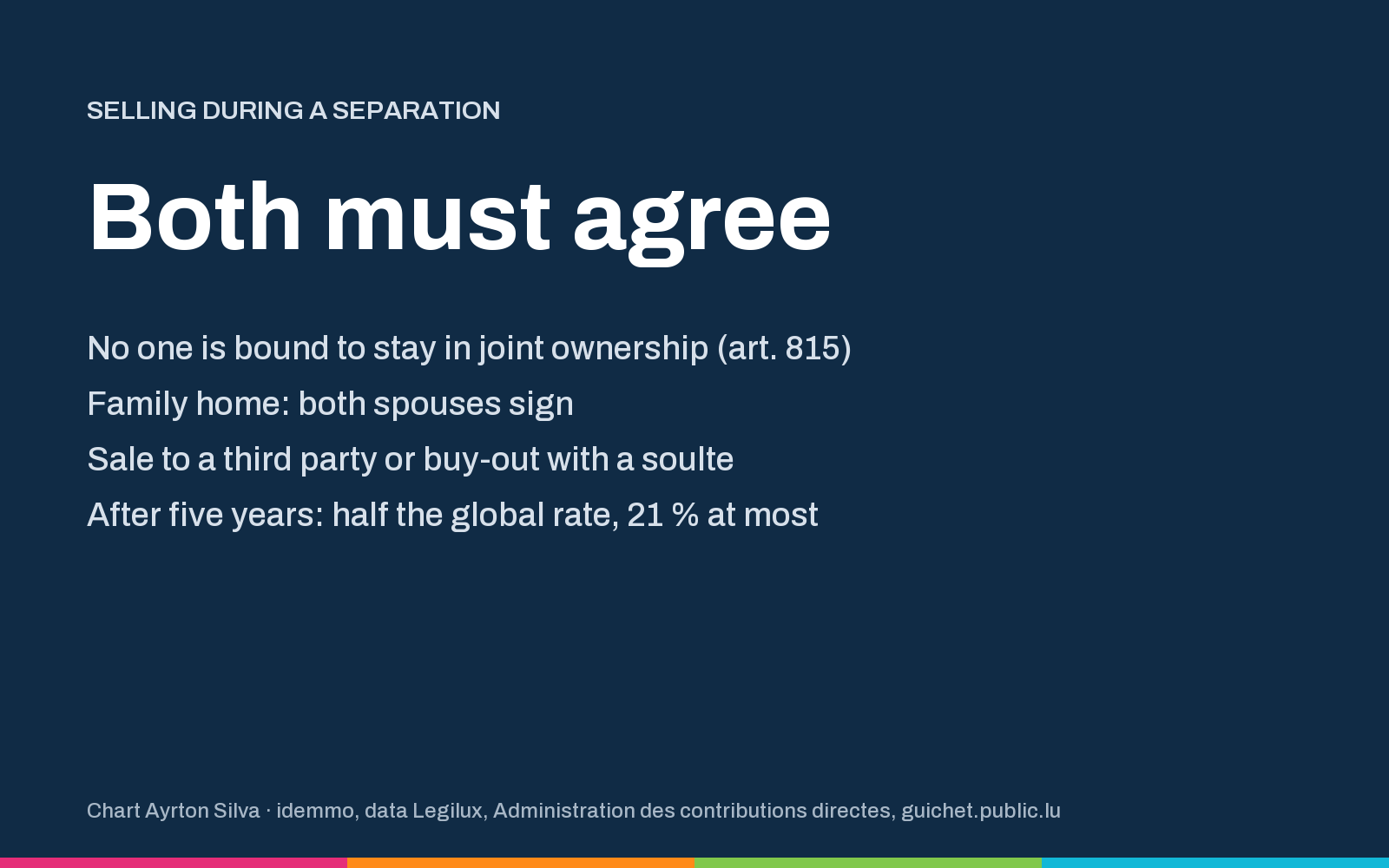
In Luxembourg, a property owned by two people is sold with the agreement of both owners, and the family home of a married couple cannot be sold without both spouses signing. By agreement, there are two routes: sell to a third party and share the price, or let one buy out the other's share against a soulte, by notarial deed. No one is bound to stay in joint ownership, and without agreement a division is requested in court, where a sale by auction is possible. Capital gains follow the usual rules: main residence exempt under conditions, including for the one who left if the sale takes place by 31 December of the year after the move, half the global rate beyond five years, 21 % at most.
Can a jointly owned property be sold during a separation?
Yes, provided both owners agree. A property bought by two people belongs to both, and its sale requires both signatures, whether the couple is married, in a declared partnership (often called PACS) or simply living together.
The Code civil also sets a way out: no one can be forced to remain in joint ownership (indivision), and a division can always be requested. The court may postpone it, for two years at most, if an immediate division risks harming the value of the property (Code civil, art. 815).1 In other words, neither can be required to stay co-owner with the other indefinitely, but neither can sell the whole property alone either.
In practice, most sales after a separation are settled amicably: both owners agree on the price, on who handles the sale and on how the proceeds are shared. When agreement does not come, the notary and, if necessary, the court take over.
Married, partners or cohabiting: what changes
The couple's legal situation determines who must sign and how the property is shared.
Married couples
For a married couple, two rules apply together.
- The family home: spouses cannot, one without the other, dispose of the rights that secure that home, even if the property belongs to only one of them. The spouse who did not consent can ask for the deed to be annulled within the year after learning of it (Code civil, art. 215).1
- The matrimonial regime: under the community regime, a spouse cannot sell real estate that entered the community through them without the other's consent (Code civil, art. 1424). The community is dissolved, among other causes, by divorce (art. 1441).1
In a divorce by mutual consent, the spouses first have a notary draw up an inventory and valuation of all their assets, real estate included, and settle their respective rights (Code civil, art. 230).1 What happens to the home is therefore decided before the court pronounces the divorce.
In a divorce for irretrievable breakdown, the judgment orders the liquidation of the matrimonial regime and appoints a notary where needed. If the spouses disagree, the notary records each side's claims in a report, and the court rules before sending the spouses back to the notary. Between the spouses, the divorce takes effect on the date of the divorce petition; towards third parties, from its transcription in the civil status registers.2
One particular case concerns families with young children. When one or more common children are under twelve, the court may grant use of the family home to the parent they live with, for two years at most after the divorce, against an occupancy payment (Code civil, art. 253).1 The sale timeline takes this into account.
Declared partners
The family home rule of article 215 concerns married spouses. Partners who bought together usually hold the property in joint ownership, in the shares stated in their purchase deed. A property agreement signed between them may set other rules: it is the first document to review with the notary.
Cohabiting couples
Without marriage or partnership, the ordinary rules of joint ownership apply. Each owns the share recorded in the purchase deed. If one wants to sell their share to a person outside the joint ownership, they must notify the price and terms to the other by bailiff's notice, and the other has one month to exercise a right of pre-emption (Code civil, art. 815-14).1 This rule applies to any property held in joint ownership, whatever the couple's status.
Sell to a third party or buy out the other's share?
By agreement, there are two routes. Neither is right in itself: the choice depends on what each person wants and what they can finance.
Sale to a third party
The property is put on the market, both owners sign the compromis de vente and then the notarial deed, and the price is shared according to each person's rights, after the loan is repaid. This route releases both from ownership and, most often, from the loan. It requires agreement on the asking price, on who organises viewings and on the negotiation margin accepted.
Buy-out and soulte
One keeps the property and buys out the other's share. They pay a soulte, the amount that balances the difference in value in the division. The operation goes through a notarial deed.
In a division deed that includes real estate, the co-sharers affirm that the deed states the full soulte agreed (loi du 28/01/1948, art. 6).3 The soulte must therefore match what was actually agreed.
The registration duties due on a division or a buy-out depend on the couple's situation and on the type of deed. This is checked with the notary before setting the soulte, because it changes the real cost of the buy-out for the one keeping the property.
Without agreement: division in court
If no agreement emerges, either owner can ask the court for a division. When a property cannot be divided conveniently and without loss, or neither can or wants to take it, it is sold by auction and the price is shared (Code civil, art. 1686).1 This route takes longer, adds procedure costs and leaves the price to the auction result. That is a reason to look for agreement on the value before it comes to that.
Who lives in the home until the sale?
While the property stays in joint ownership, the one who occupies it alone owes the other an indemnity in principle, unless agreed otherwise (Code civil, art. 815-9).1 For a married couple with common children under twelve, the article 253 rule described above may apply.
As soon as one of the two moves out, it helps to set down in writing who lives in the home, who pays the instalments and charges, and how these amounts will be counted at the division.
What happens to the mortgage?
A separation does not change the loan contract. If both borrowed together, the bank normally keeps its rights against both borrowers until the loan is repaid or the bank agrees to release one of them.
- In a sale to a third party, the loan is usually repaid from the sale price at the notarial deed, and the balance is shared.
- In a buy-out, the one keeping the property often has to take over the existing loan alone or obtain new financing. The bank then assesses repayment capacity on that person's income alone.
It helps to ask the bank, at the start, for the outstanding capital and the conditions for early repayment. These two figures shape the net amount each person will receive.
Capital gains and tax
A sale after a separation follows the usual rules of the Administration des contributions directes.4
- Resale less than five years after acquisition: speculative gain, taxed at the ordinary progressive rate according to the owner's situation.
- Beyond five years: disposal gain, taxed at half the global rate, 21 % at most.
- An allowance of 50 000 € over ten years applies, raised to 100 000 € for spouses or partners taxed jointly.
The gain on the seller's main residence is not taxable, under conditions. After a separation, one of the two has often left the home before the sale. For that person, the exemption remains possible if the sale takes place by 31 December of the year after the move and the other conditions are met.5 This deadline weighs on the timeline: note the date of the move, and check that person's situation with the Administration des contributions directes or with the notary.
The year of the sale matters too. Spouses remain taxed jointly in the year the divorce takes effect; for partners, joint taxation is excluded in the year the partnership ends.6 The date of the sale relative to the divorce or the end of the partnership is therefore looked at before signing.
Why a neutral valuation helps
In a separation, the price is rarely a neutral subject. The one who wants to keep the property has an interest in a low value, the one who leaves in a high value. A written valuation, based on comparable recorded sales and the condition of the property, gives both the same basis for discussion.
- For a sale to a third party, it sets the asking price and the negotiation margin accepted.
- For a buy-out, it is the starting point for the soulte, which the notary includes in the deed.
- In a disagreement, it lets both discuss facts rather than impressions.
A valuation replaces neither the notary nor, where relevant, an expert appraisal ordered by a court. It simply avoids each person arriving with their own figure.
A practical timeline
Every separation has its own pace. The following steps come up in most cases.
- Gather the documents: purchase deed, marriage contract or partnership agreement, loan repayment schedule, energy performance certificate (CPE), plans and invoices for works.
- Ask the bank for the outstanding capital and the conditions for early repayment.
- Obtain a written valuation, shared between both owners.
- Choose the route, sale to a third party or buy-out, and check with the notary the duties and taxes of each option. If one of the two has moved out, keep the main residence exemption deadline in mind.
- For a sale to a third party: sign the mandate together, prepare the property, sign the compromis and then the notarial deed.
- For a buy-out: secure financing for the one keeping the property, then sign the notarial deed of division or transfer.
- Work out each person's net after loan repayment, costs and tax, with the net seller tool.
Each situation is checked with the notary, who draws up the deed and explains the consequences specific to the couple.
Sources
- Code civil luxembourgeois, texte consolidé au 26/12/2025 · Legilux · 15/11/2026
- Divorce pour rupture irrémédiable des relations conjugales · guichet.public.lu · 15/11/2026
- Loi modifiée du 28/01/1948 sur la perception des droits d'enregistrement · Legilux, loi modifiée du 28/01/1948 · 15/11/2026
- Vente d'un immeuble : imposition du bénéfice · Administration des contributions directes · 15/11/2026
- Plus-value sur la vente de l'habitation principale · guichet.public.lu · 15/11/2026
- Implications fiscales en cas de divorce, de séparation ou de fin de partenariat · guichet.public.lu · 15/11/2026
Every figure in the article points to a public source, cited with its date. Sources are in French.
Frequently asked questions
Can my former spouse block the sale of our house?
A property owned by two people is sold with the agreement of both. Without agreement, no one is bound to stay in joint ownership: a division can be requested in court, and if neither can or wants to keep the property, it can be sold by auction. This route takes longer and leaves the price to the auction result. The notary explains the procedure that fits your situation.
Is it wiser to sell to a third party or for one of us to buy out the other?
It depends on what each of you wants and can finance. A buy-out means the one keeping the property obtains their own financing and pays the other a soulte. A sale to a third party releases both. A written valuation serves as the basis in both cases.
Is the sale of our main residence taxed after a separation?
The gain on the seller's main residence is not taxable, under conditions. The one who left the home can keep this exemption if the sale takes place by 31 December of the year after the move and the other conditions are met. That person's situation is checked with the Administration des contributions directes or with the notary.
Are partners and cohabiting couples in the same position as spouses?
Not quite. The family home rule concerns married spouses. Partners or cohabitants who bought together usually hold the property in joint ownership, according to their purchase deed and their agreement. The notary checks this before any sale.
Request my written valuation
Property address, commune, a word about your plans: Ayrton calls you back.
Prefer a message? One word is enough.
Send ESTIMATION on WhatsAppRead next
Selling a rented property in Luxembourg: the tenant's lease
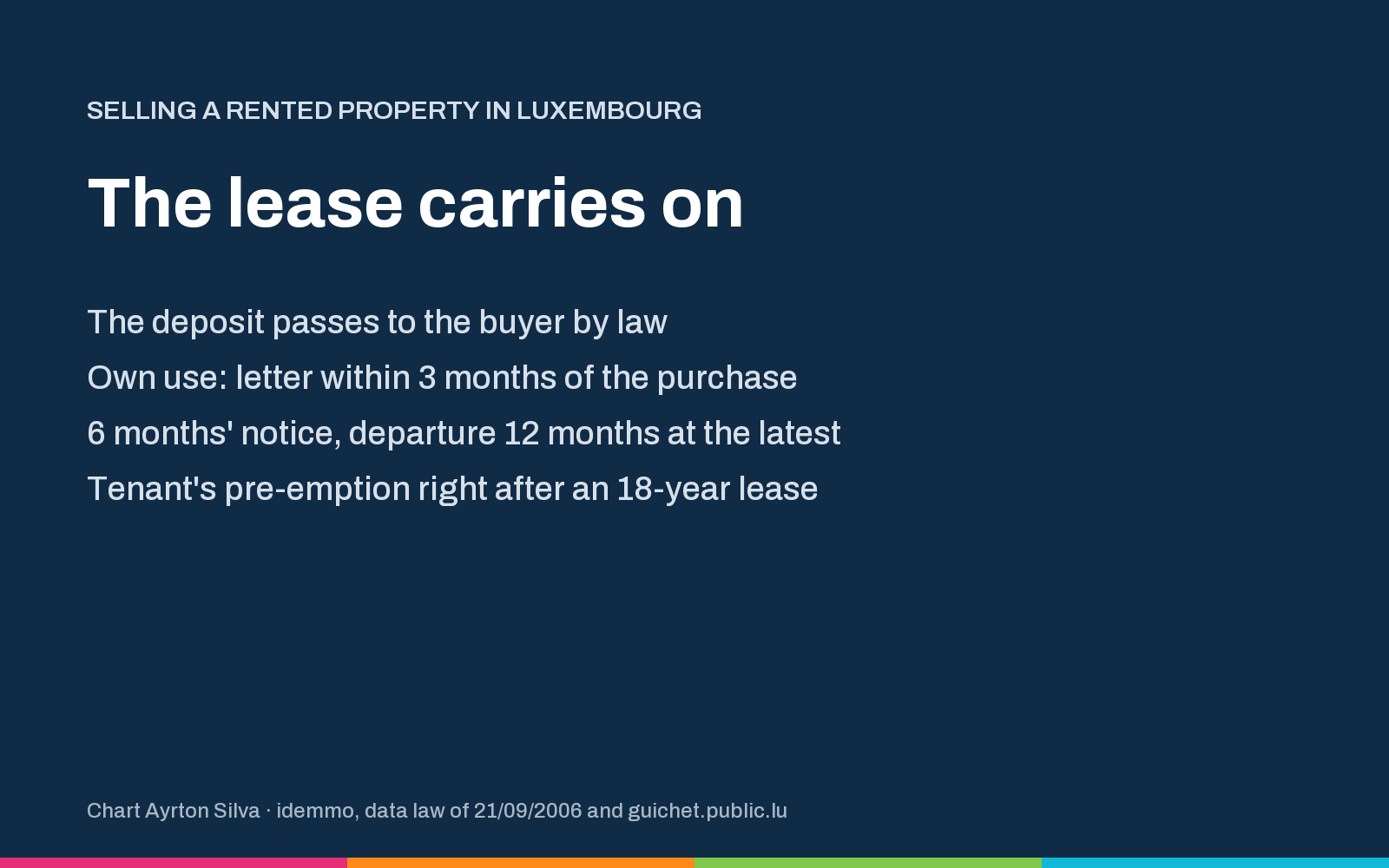
In Luxembourg, selling a rented home does not end the lease: it carries on with the buyer, and the sale is not a serious ground for making the tenant leave. The deposit passes to the new owner by law. A buyer who wants to live in the home sends a termination letter within 3 months of the purchase, with a notice period of 6 months, and the tenant leaves 12 months after the letter at the latest. After an 18-year lease, the tenant may hold a pre-emption right.
Purchase offer in Luxembourg: what the seller checks
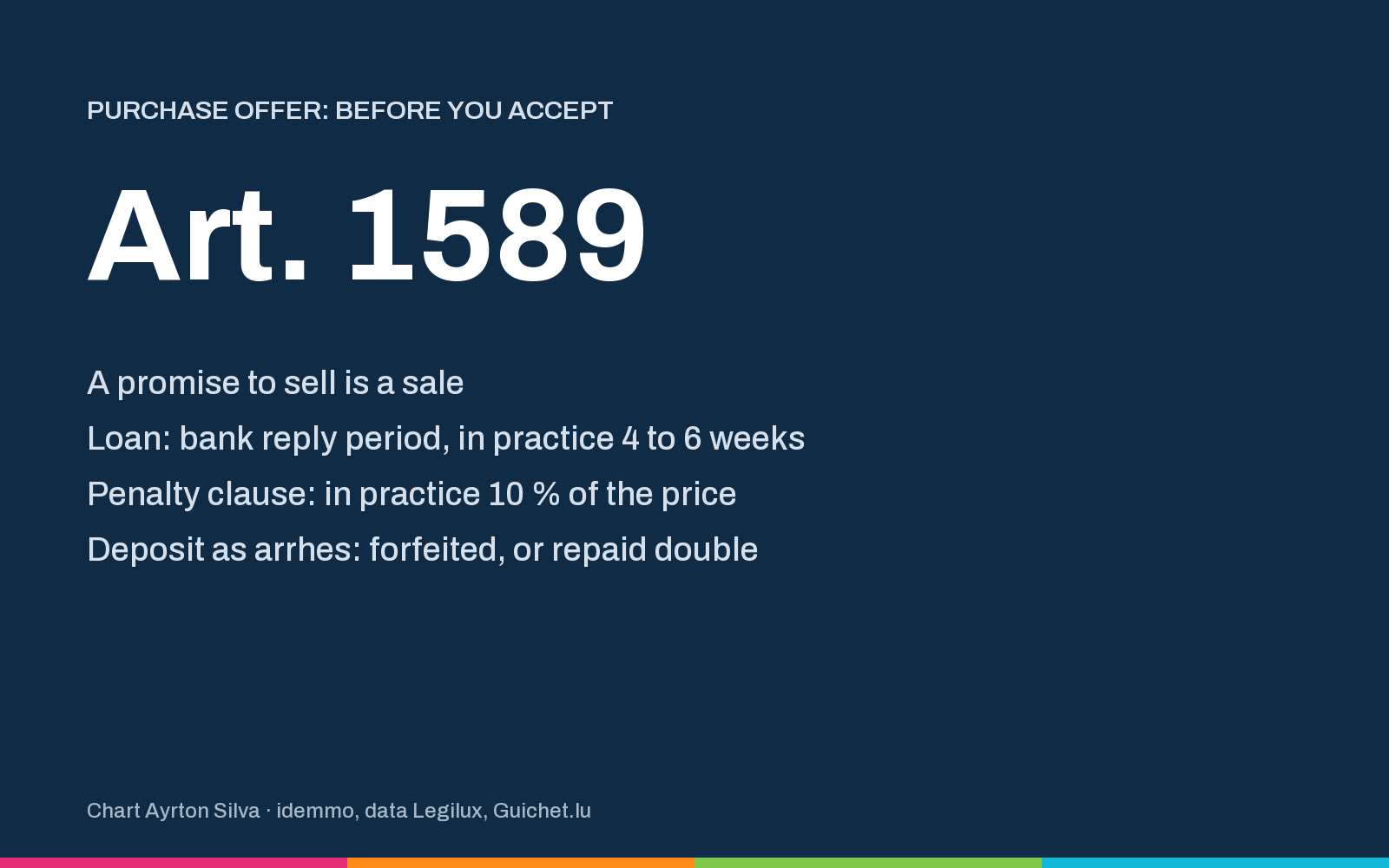
In Luxembourg, a sale is complete as soon as seller and buyer agree on the property and on the price (Civil Code, art. 1583). Accepting an offer in writing can therefore already bind you. Before signing, read the loan condition and its deadline, the nature of any sum paid and the planned date of the deed.
Documents to sell a property in Luxembourg: the checklist
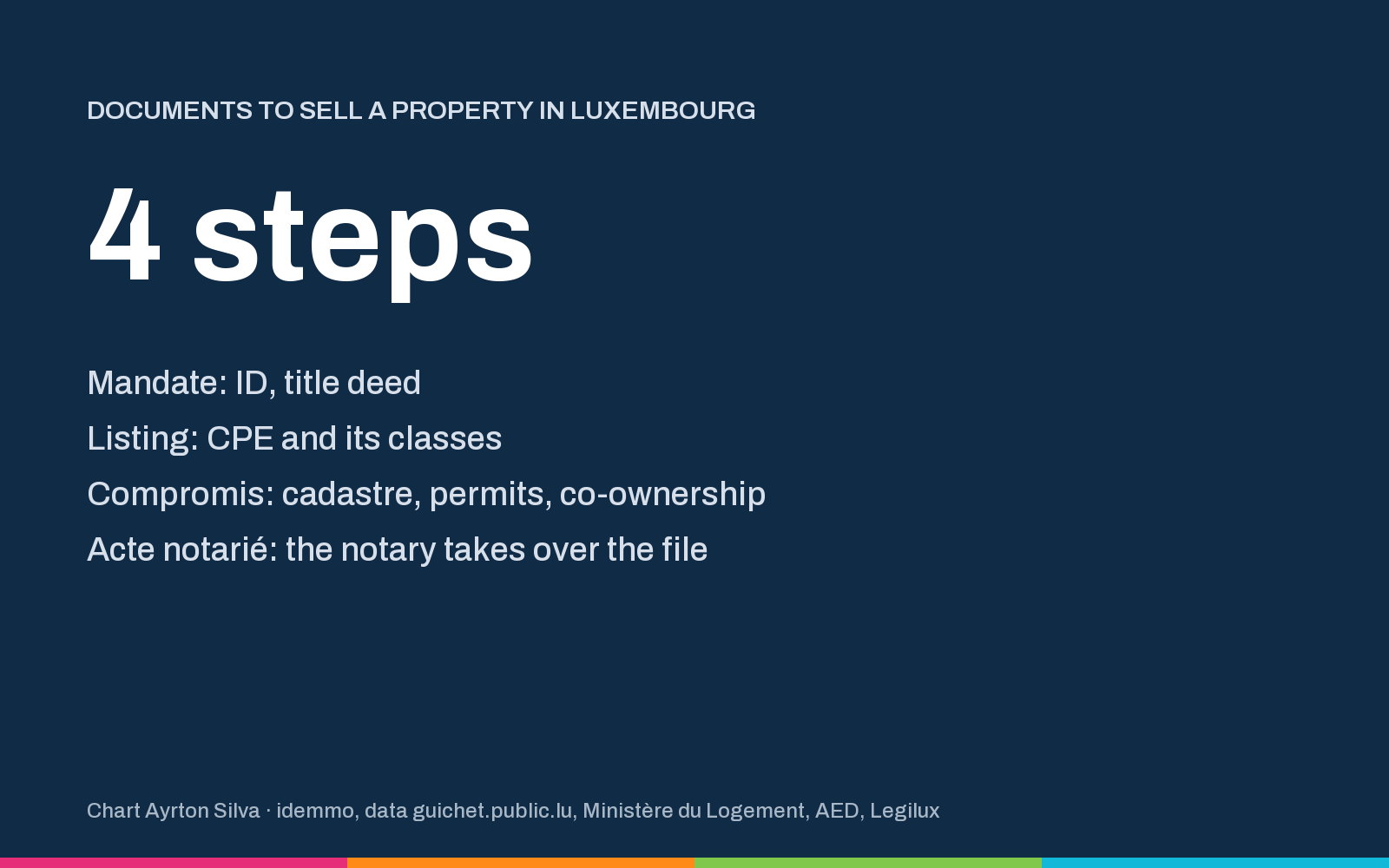
A sale in Luxembourg runs through four steps: the mandate, the listing, the compromis de vente and the acte notarié. The CPE, valid for 10 years, must exist before the listing, which shows its classes. The title deed, the cadastral extract, the building permits and, in a co-ownership, the tableau descriptif de division and the balance of the works fund are gathered before the compromis.