

Guide
Purchase offer in Luxembourg: what the seller checks
In Luxembourg, a sale is complete as soon as seller and buyer agree on the property and on the price (Civil Code, art. 1583). Accepting an offer in writing can therefore already bind you. Before signing, read the loan condition and its deadline, the nature of any sum paid and the planned date of the deed.
Is an accepted purchase offer already a sale?
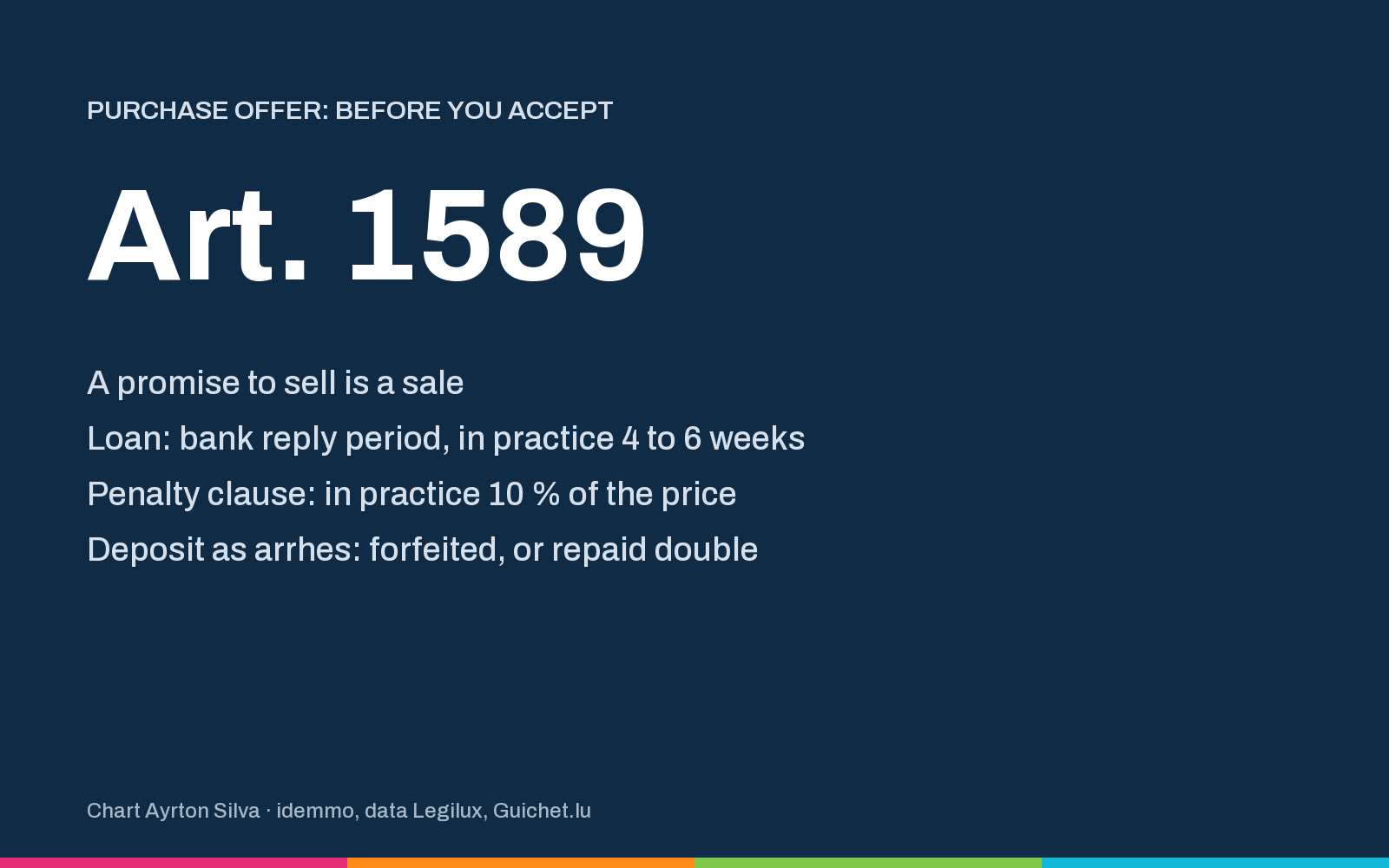
In Luxembourg, a sale is complete between the parties as soon as they agree on the property and on the price, even if the property has not yet been handed over or the price paid (Civil Code, art. 1583).1 The Code adds that a promise to sell is worth a sale when both parties consent to the property and the price (art. 1589).1 Guichet.lu sums it up for the compromis de vente: once signed by both parties, it commits them to complete the sale at the agreed price, and in principle neither can withdraw.2
For a seller, the consequence is practical. A written purchase offer that identifies the property and sets a price, countersigned « bon pour accord », can have the same effect as a compromis. Agreements lawfully entered into have the force of law for those who made them and can only be revoked by mutual consent (art. 1134).1 Signing at the bottom of an offer is not a courtesy: it is the moment the terms are fixed.
This guide covers that moment, between the offer and the compromis. Registration of the compromis, its cost, the floor area and the family home are covered in our article on the path from compromis to notarial deed.
What must a purchase offer contain?
A serious offer fits on one page, but every line counts. Before discussing it, check that it contains:
- The full identity of the buyer, and of each buyer if two are buying together.
- The property, described without ambiguity: address, unit, cellar, parking space, what is sold with it.
- The price, in figures and in words, and what it includes. The Civil Code requires the price to be determined and stated by the parties (art. 1591).1
- The financing: own funds, use of a loan, amount of the planned loan.
- The conditions set by the buyer, a loan or anything else.
- The offer deadline: until when the buyer stands by it.
- The intended dates for the compromis and for the deed.
An offer without a deadline leaves you in the dark, because you do not know how long the buyer considers themselves bound. An offer that says nothing about financing forces you to ask, and the answer weighs as much as the price.
Loan condition: what deadline, what proof?
Guichet.lu notes that almost every compromis makes the sale subject to conditions, and names a bank loan first. The compromis then provides that the buyer is only obliged to buy once that loan is granted. Guichet.lu sets out three points that matter to the seller:2
- The period for the bank's reply is fixed in writing by the parties. The law imposes no length; in practice it is at least 4 to 6 weeks.
- The period can be extended if the buyer produces an official letter from the bank confirming that the application has been filed and is being processed.
- In a dispute, the buyer must prove that they applied to at least one bank in time and informed the seller of the answer within the period.
The Civil Code completes the picture. It allows a sale to be made subject to a suspensive condition (art. 1584).1 A condition tied to a fixed period is deemed to have failed when that period expires without the event taking place (art. 1176).1 And a condition is deemed fulfilled when the party bound by it prevented it from being fulfilled (art. 1178).1 A buyer who never applies for a loan therefore cannot hide behind the condition.
For you as the seller, a well-drafted loan clause sets the maximum loan amount applied for, the reply deadline and the form of proof: a refusal letter from the bank, not a mere statement by the buyer. Without a date, the condition stays open: the Code provides that a condition with no fixed period can always still be fulfilled (art. 1176)1; without an amount, a buyer can apply for an unrealistic loan and obtain a refusal.
Several offers: how do you compare them?
When two or three offers come in, the reflex is to look at the price first. It is one criterion, not the only one. Three questions often separate close offers:
- Certainty of financing. A buyer with solid own funds, or a written agreement in principle from their bank, carries less risk than a buyer who is just starting the process.
- Conditions. An offer with no loan condition, or with a short one, keeps you in uncertainty for less time. An offer subject to the sale of another property adds a condition you have no control over.
- Timing. The date of the deed has to fit your own plans: buying another property, moving, repaying an existing loan.
A slightly lower offer that is financed and quick can count for more than a higher offer subject to two conditions. Score each offer on these criteria, in writing, before you reply.
One precaution applies when several buyers are in the running: accept only one offer at a time. Two written acceptances for the same property expose you to the buyer you do not choose.
How do you make a counter-offer?
If the offer does not suit you, reply in writing with a complete counter-offer: price, conditions, loan condition period, date of the deed, and a deadline for your own reply. A counter-offer changes the terms: do not count on the original offer as if it were still on the table. If the buyer accepts your terms in writing, agreement on the property and the price may be reached at that moment (art. 1583 and 1589).1
Arrhes, down payment, penalty clause: what is the difference?
A sum is often paid when the compromis is signed. What it is called is not a detail. If the promise to sell is made with arrhes, each party remains free to withdraw: the one who paid them by forfeiting them, the one who received them by repaying double (art. 1590).1 A sum described as arrhes therefore opens an exit, for both parties. By contrast, a sum paid as an advance on the price, not described as arrhes, gives no such right to withdraw: the agreement remains governed by art. 1134. Have it written down on what basis the sum is paid, who holds it until the deed and what happens to it if the loan condition is not met.
The compromis can also include a penalty clause: a fixed indemnity owed by the party who refuses to complete. In practice it is set at 10 % of the sale price, that is 35 000 € for a price of 350 000 €.2 Check who it applies to: drafted for both parties, it also covers a seller who changes their mind or finds a buyer offering more after the compromis. A judge can reduce or increase the penalty if it is manifestly excessive or derisory (art. 1152).1
The checklist before accepting
Before signing an offer or a compromis, go through these points one by one:
- The offer identifies the property and the price without ambiguity.
- It carries a deadline, and you reply before it.
- The financing is described: own funds, loan amount, bank approached.
- The loan condition sets a maximum amount, a deadline and written proof of refusal.
- Any other conditions are written down and dated.
- The sum paid is described: arrhes or not, held by whom.
- You have read the penalty clause, and you know it binds you too.
- The date of the deed fits your own timetable.
- Only one offer is accepted at a time.
To judge an offer, you first need to know what the property is worth. A written valuation gives you a reference figure to answer a low offer or to choose between two close ones. Request yours.
Sources
- Code civil luxembourgeois, texte consolidé · Legilux, Code civil luxembourgeois · 15/11/2026
- Connaître le contenu et la valeur juridique d'un compromis de vente · Guichet.lu, portail du gouvernement luxembourgeois · 15/11/2026
Every figure in the article points to a public source, cited with its date. Sources are in French.
Frequently asked questions
Is an accepted purchase offer already a sale in Luxembourg?
It can be. A sale is complete once the parties agree on the property and the price (Civil Code, art. 1583), and a promise to sell is worth a sale on the same terms (art. 1589). If the offer fixes the property and the price without reservation, your written acceptance may be enough to bind you.
How long does the loan condition last?
The law sets no period: the parties write it into the compromis. In practice the bank's reply period is at least 4 to 6 weeks, and it can be extended on an official letter from the bank.
What happens if the buyer pulls out after the compromis?
In principle the buyer cannot. If the compromis has a penalty clause, it is owed by the party who refuses to complete, under the terms of the clause; in practice it is set at 10 % of the price. A judge can reduce it if it is manifestly excessive.
Arrhes or down payment: what is the difference for the seller?
With arrhes, either party can withdraw: the buyer by forfeiting them, the seller by repaying double (Civil Code, art. 1590). An advance on the price, not described as arrhes, gives no such right. Have it written down on what basis the sum is paid and who holds it until the deed.
Request my written valuation
Property address, commune, a word about your plans: Ayrton calls you back.
Prefer a message? One word is enough.
Send ESTIMATION on WhatsAppRead next
Documents to sell a property in Luxembourg: the checklist
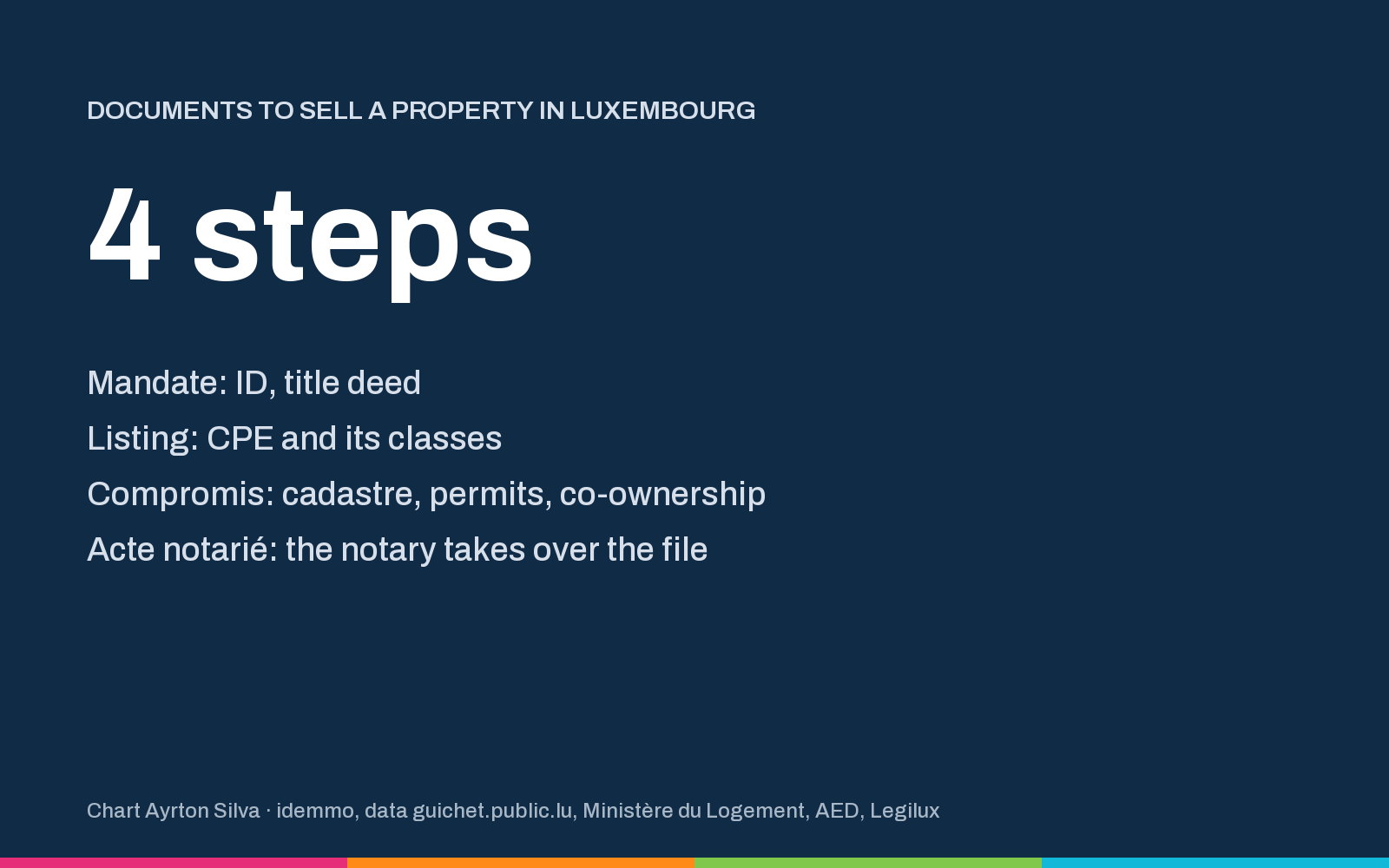
A sale in Luxembourg runs through four steps: the mandate, the listing, the compromis de vente and the acte notarié. The CPE, valid for 10 years, must exist before the listing, which shows its classes. The title deed, the cadastral extract, the building permits and, in a co-ownership, the tableau descriptif de division and the balance of the works fund are gathered before the compromis.
Selling and buying again in Luxembourg: which comes first?
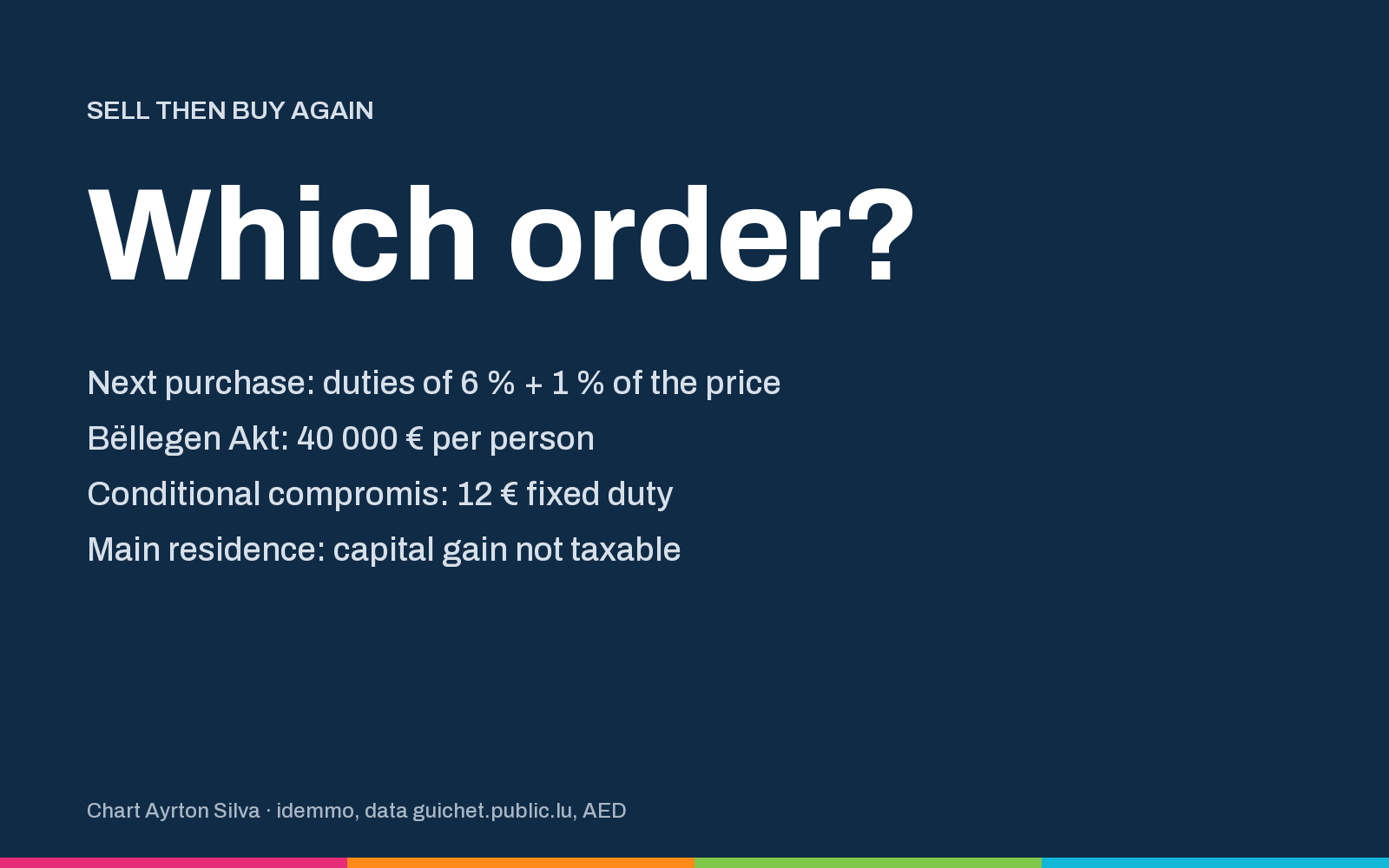
Selling first fixes your budget but may mean a temporary home; buying first secures your next home but needs transition financing. Either way, the next purchase carries duties of 6 % and 1 % of the price, reduced by the Bëllegen Akt of 40 000 € per person if credit remains, and the capital gain on your main residence is not taxable if the deadlines are met.
From compromis de vente to acte notarié: deadlines and costs
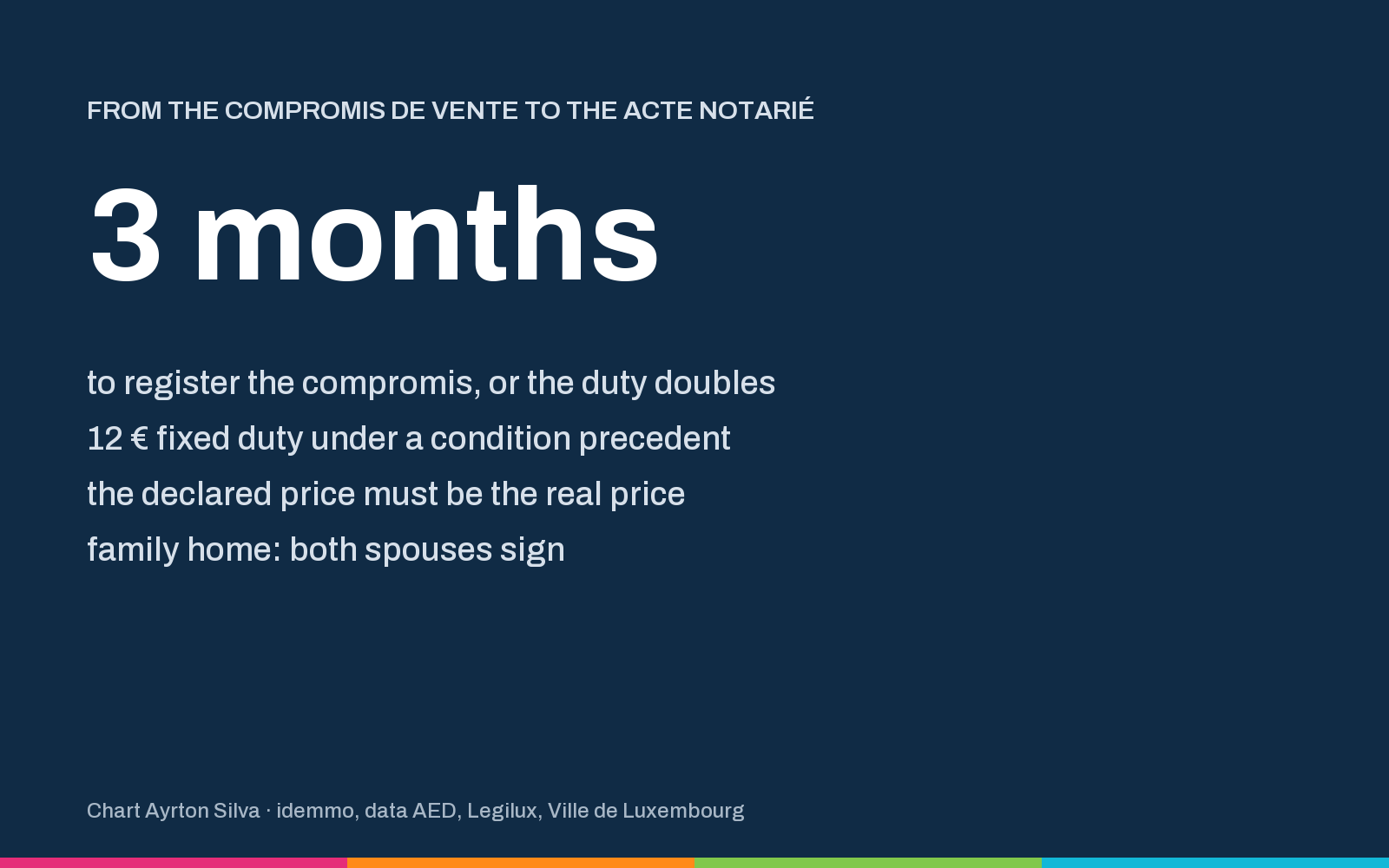
In Luxembourg, a private compromis de vente must be registered within three months, otherwise the double duty applies. While the condition precedent is not met, only a fixed duty of 12 € is due. The declared price must be the real price, and the family home can only be sold with both spouses' consent.
Luxembourg