

Guide
Documents to sell a property in Luxembourg: the checklist
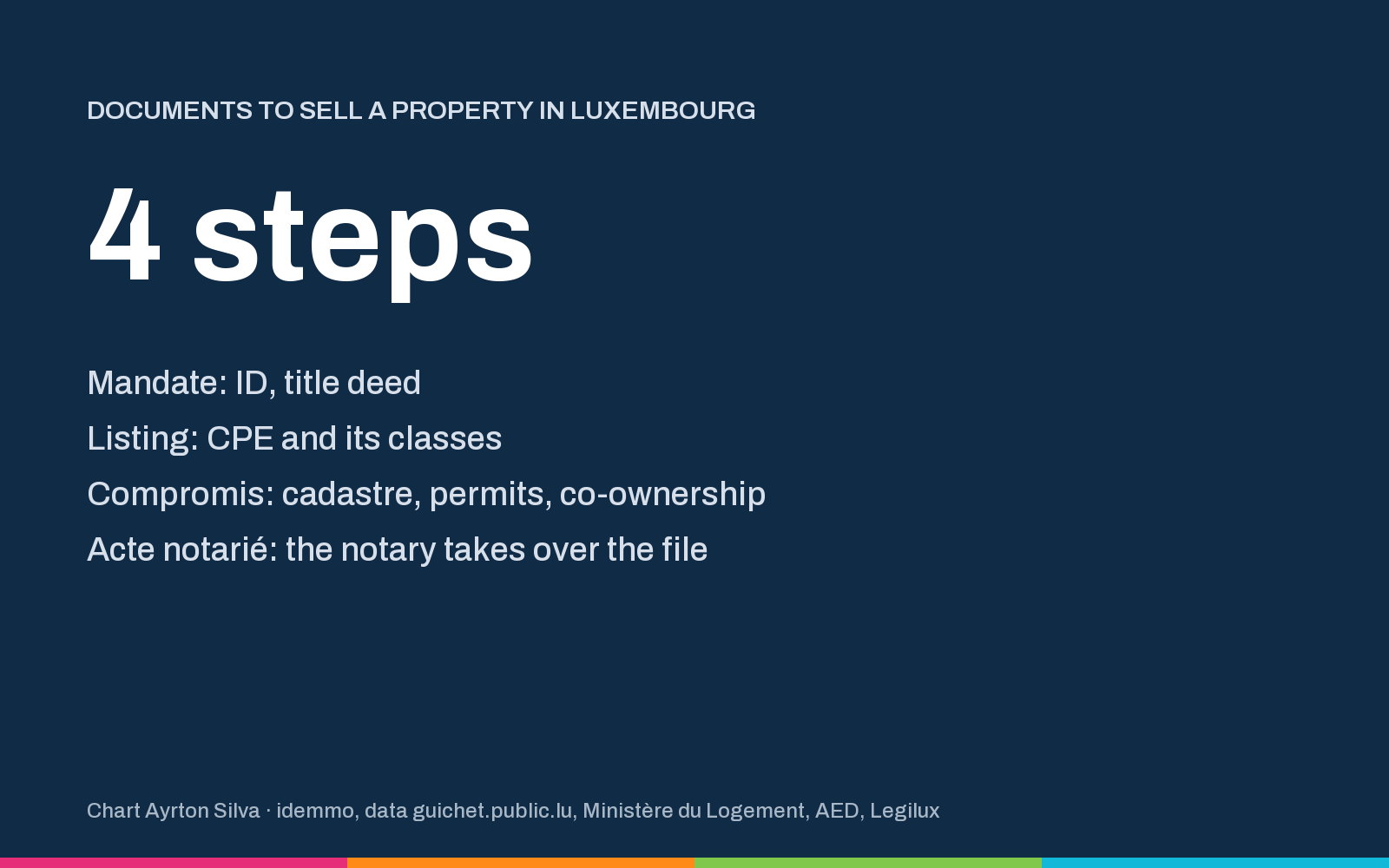
A sale in Luxembourg runs through four steps: the mandate, the listing, the compromis de vente and the acte notarié. The CPE, valid for 10 years, must exist before the listing, which shows its classes. The title deed, the cadastral extract, the building permits and, in a co-ownership, the tableau descriptif de division and the balance of the works fund are gathered before the compromis.
Which documents do you need to sell a property in Luxembourg?
A sale is prepared in four steps, and each one calls for its own papers: the mandate, the listing, the compromis de vente, then the acte notarié. The CPE must exist before the listing. The title deed, the cadastral extract, the building permits and, in a co-ownership, the file on the lot are gathered before the compromis: that is where the price, the description of the property and the conditions are set. The notary reviews everything before the deed, but works from what the seller has handed over.
| Document | Who provides it | For which step |
|---|---|---|
| Sellers' identity documents | The seller | Mandate |
| Title deed (purchase deed, gift deed or inheritance papers) | The seller, or the notary who received the deed | Mandate |
| Energy performance certificate (CPE) | An architect, a consulting engineer or an approved expert, at the seller's request | Listing |
| Cadastral extract and cadastral plan | Administration du cadastre et de la topographie | Compromis |
| Building permits and plans | The seller, otherwise the commune | Compromis |
| Tableau descriptif de division | Administration du cadastre et de la topographie | Compromis, co-owned lot |
| Co-ownership rules, general meeting minutes, service charge statements, works fund balance | The syndic | Compromis, co-owned lot |
| Consent of both spouses for the family home | The sellers | Mandate and compromis |
At the mandate: who is selling, and what
The first document is identity. Under the law of 12 November 2004 on the fight against money laundering, the estate agent identifies its clients, sellers and buyers alike, before entering a business relationship, on a copy of an identity document.8 When the property belongs to a company, its beneficial owners are identified in the same way. This is not an agency formality: it is the law.
The second is the title deed. Depending on how the property was acquired, it is the purchase deed, the gift deed or the inheritance papers. If your copy is lost, the notary who received the deed keeps the original. For an inherited property, the article on selling an inherited property explains what the heirs decide together.
The third point is often overlooked: the family home. Spouses cannot dispose of the rights that secure it without each other, and annulment can be sought within the year (Code civil, art. 215).10 If the property houses the family, selling it therefore needs the consent of both spouses, even if only one name appears on the title. Have both sign from the mandate onwards: the compromis binds the sale, and a refusal at that stage is costly.
Finally, the mandate is itself an intermediary's deed: it is registered within ten days of its date, or the double duty applies.9
Before the listing: the CPE
The energy performance certificate is required at every change of owner, and it is valid for 10 years.1 It rates the home from A+ to I on three scales: energy performance, thermal insulation and environmental impact. It is issued by an architect or consulting engineer who is a member of the OAI, or by an expert approved by the Ministry of the Economy; the seller chooses the expert and pays the fee. On the sale, the original CPE is handed to the new owner.1
The CPE governs the listing. Sale and rental listings published in commercial media show the energy performance class and the thermal insulation class, as they appear on a valid certificate (amended grand-ducal regulation of 30 November 2007).1 Without a CPE, the listing waits. An older certificate may also no longer be enough after works: the article on the CPE and selling sets out the thresholds and the grants.
Before the compromis: the property, its plot and its surfaces
The cadastral extract
The compromis must contain at least the names and addresses of the parties, the description of the property with its cadastral references, the price and the payment terms.2 The references come from the cadastral extract, issued by the Administration du cadastre et de la topographie. Notaries, property professionals and private individuals can request it; depending on the need, it includes the ownership record, the certificate of the year of construction, the chain of title or a copy of a survey.3 Ordering is done online: the electronic version arrives as a PDF, the paper version is charged.
The survey plan
For a house, the plot matters as much as the building. When a plot is divided for a sale, the new parcels are described in an official survey plan drawn up by a géomètre officiel.4 Selling part of the garden, or a building plot split off from the house, therefore requires that plan before the compromis.
The living area
The advertised surface is binding. The price is adjusted only if the gap between the real measurement and the one in the contract reaches one twentieth (Code civil, art. 1618-1619).10 Measuring the living area before the listing avoids the argument at the moment it becomes costly, between the compromis and the deed.
Building permits
The building permit is issued by the bourgmestre of the commune where the property is located, for any construction, alteration or demolition.5 An extension, a conservatory, converted lofts or an apartment created inside a house are alterations: the buyer and their notary will ask for the matching permit. If your copy is lost, the commune is the place to ask. Floor space built without a permit is hard to sell, because nobody can say what will become of it.
In a co-ownership: the file on the lot
An apartment is sold together with the building around it. The file comes in three parts.
The vertical cadastre. A lot in a co-ownership can be transferred only if the tableau descriptif de division, approved by the Administration du cadastre et de la topographie, is provided (law of 19 March 1988 on land registration in co-ownership matters).6 In an older building never divided in the cadastre, this is the longest step on the list: it goes through an architect, a consulting engineer or a surveyor.
The rules and the accounts. The co-ownership rules, or acte de base, set out the private parts, the common parts and the shares in thousandths. The minutes of the latest general meetings show the works voted or discussed; the service charge statements show what the lot costs each year. The syndic supplies them. A buyer who reads them before the compromis signs with full knowledge; a buyer who finds them afterwards negotiates.
The works fund. The law of 30 June 2022, amending the law of 16 May 1975 on co-ownership, has made a works fund compulsory since 1 August 2023 (article 11bis).7 The minimum contribution depends on the thermal insulation class shown on the building's CPE. The fund's assets stay with the lots when they are sold: they are not paid back to the seller, they pass with the apartment. An interested buyer can consult the balance of contributions held for the lot, and a healthy balance is a selling point.
At the compromis, then at the deed
The compromis counts as the sale: once both parties sign, it commits them to complete at the agreed price and in principle cannot be withdrawn from.2 It usually includes a condition precedent, the buyer obtaining a loan, and it is registered within 3 months of signature.2 The deadlines and duties are covered in the article on the compromis and the acte notarié.
The sale of a property is concluded by notarial deed to be enforceable against third parties.2 The notary takes up the documents gathered for the compromis, checks that the seller owns the property and searches for mortgages, easements and other charges.2 If a loan is still outstanding on the property, give the notary its details at the compromis: the mortgage will show up in the searches anyway. The more complete the file at the compromis, the fewer surprises at the deed.
The seller's checklist
- Identity document of each seller, and of the representatives if a company owns the property.
- Written consent of both spouses if the property is the family home.
- Title deed: purchase deed, gift deed or inheritance papers.
- A valid CPE, ordered before the listing goes online.
- Cadastral extract with the ownership record and the cadastral plan.
- Official survey plan if a plot is divided.
- Measurement of the living area.
- Building permits and plans for any extension or alteration.
- In a co-ownership: tableau descriptif de division, co-ownership rules, minutes of the latest general meetings, service charge statements, works fund balance.
- Details of the current loan if the property is still mortgaged.
- If the property is let: the lease and the check-in inventory, see the article on selling a let property.
- A list of what stays in the property, and of any known easements.
Before gathering these papers, a written valuation sets a defensible price, figure by figure. Request yours.
Sources
- Certificat de performance énergétique (passeport énergétique) : demande · guichet.public.lu · 15/11/2026
- Connaître le contenu et la valeur juridique d'un compromis de vente · guichet.public.lu · 15/11/2026
- Demander un extrait cadastral · guichet.public.lu · 15/11/2026
- Demander un mesurage de sa propriété · guichet.public.lu · 15/11/2026
- Demander une autorisation de bâtir pour toute construction, transformation ou démolition d'un bâtiment · guichet.public.lu · 15/11/2026
- Demander le tableau descriptif de division d'un immeuble collectif (cadastre vertical) · guichet.public.lu · 15/11/2026
- Introduction d'un fonds de travaux dans les copropriétés · Ministère du Logement · 15/11/2026
- Guide des obligations professionnelles en matière de lutte contre le blanchiment, secteur immobilier · Administration de l'enregistrement, des domaines et de la TVA (AED) · 15/11/2026
- Loi modifiée du 28/01/1948 sur la perception des droits d'enregistrement · Legilux, loi modifiée du 28/01/1948 · 29/10/2026
- Code civil luxembourgeois, texte consolidé · Legilux, Code civil luxembourgeois · 29/10/2026
Every figure in the article points to a public source, cited with its date. Sources are in French.
Frequently asked questions
Is the CPE required before putting a property on the market?
Yes. It is required at every change of owner and valid for 10 years. A sale listing shows the energy performance class and the thermal insulation class, so the certificate has to exist before the listing goes live.
Where do I get a cadastral extract in Luxembourg?
From the Administration du cadastre et de la topographie, through its online ordering service. The owner, the notary or the agent can request it; the electronic version arrives as a PDF, the paper version is charged.
What happens to the works fund when I sell an apartment?
The works fund stays with the lot: it is not paid back to the seller and passes with the apartment. An interested buyer can consult the balance of contributions held for the lot.
Do I need the building permit for an old extension?
Yes, as far as possible. Building permits are issued by the bourgmestre; if your copy is lost, the commune where the property sits is the place to ask. A buyer and their notary will raise the question for any visible alteration.
Request my written valuation
Property address, commune, a word about your plans: Ayrton calls you back.
Prefer a message? One word is enough.
Send ESTIMATION on WhatsAppRead next
Selling and buying again in Luxembourg: which comes first?
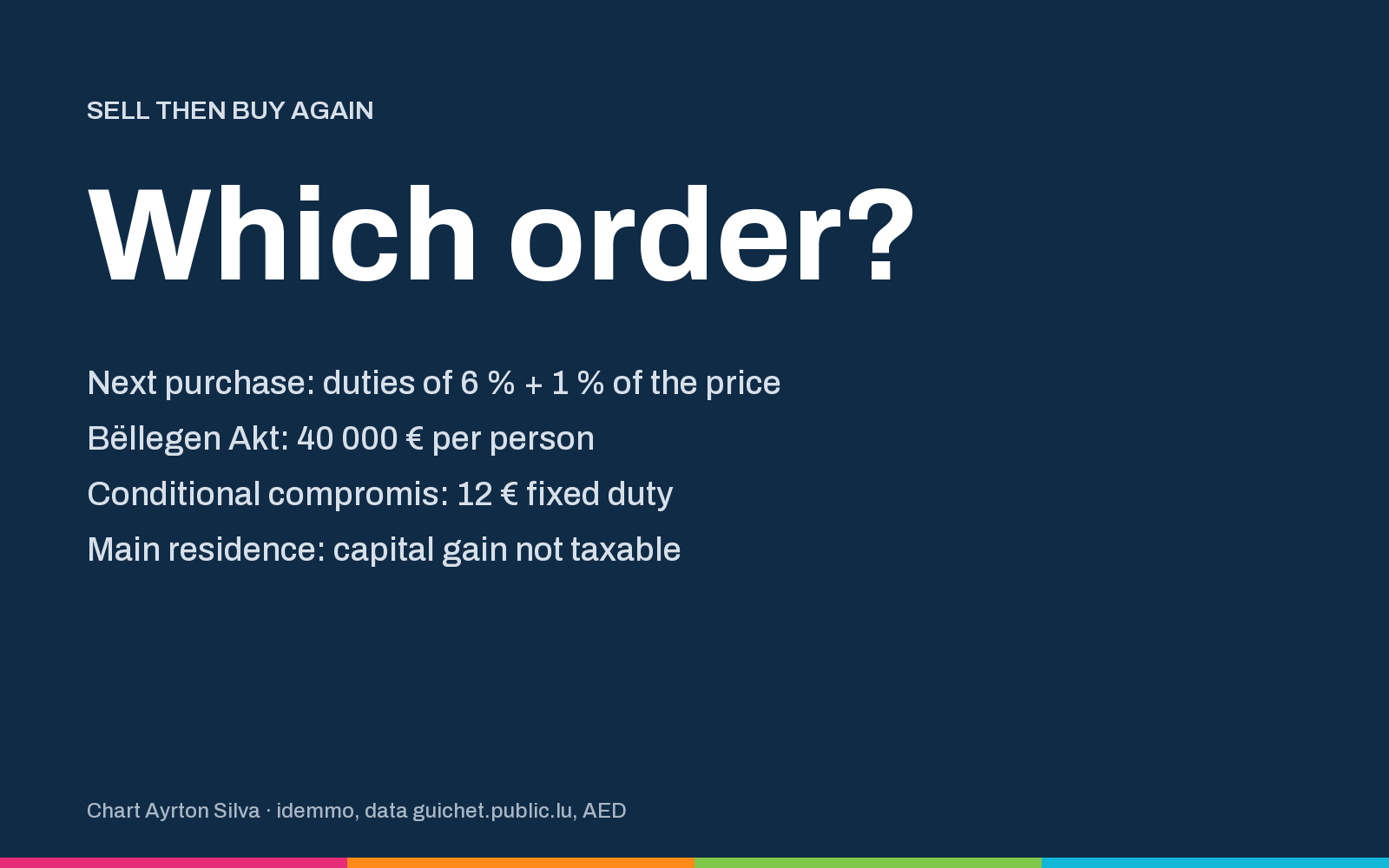
Selling first fixes your budget but may mean a temporary home; buying first secures your next home but needs transition financing. Either way, the next purchase carries duties of 6 % and 1 % of the price, reduced by the Bëllegen Akt of 40 000 € per person if credit remains, and the capital gain on your main residence is not taxable if the deadlines are met.
Purchase offer in Luxembourg: what the seller checks
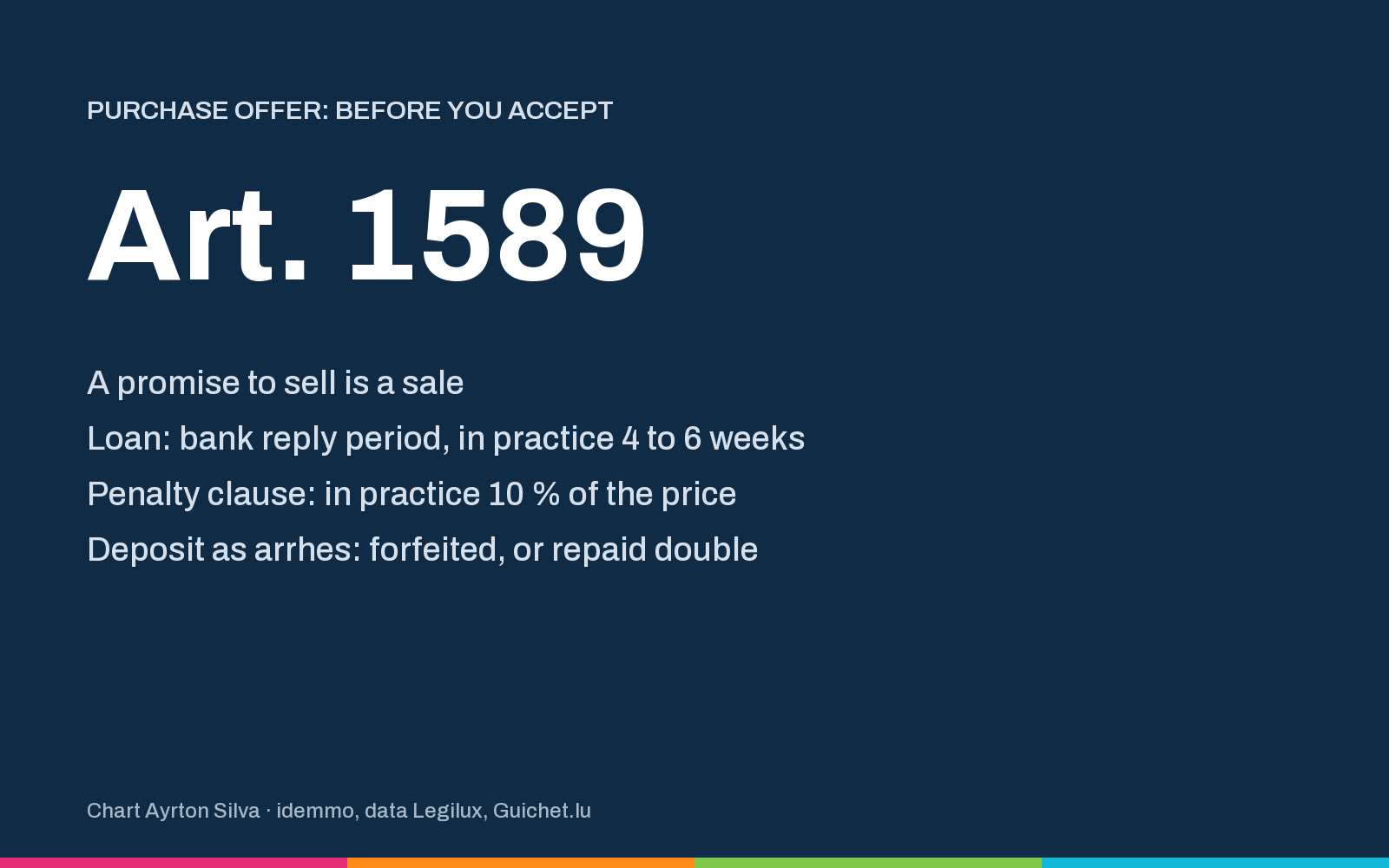
In Luxembourg, a sale is complete as soon as seller and buyer agree on the property and on the price (Civil Code, art. 1583). Accepting an offer in writing can therefore already bind you. Before signing, read the loan condition and its deadline, the nature of any sum paid and the planned date of the deed.
From compromis de vente to acte notarié: deadlines and costs
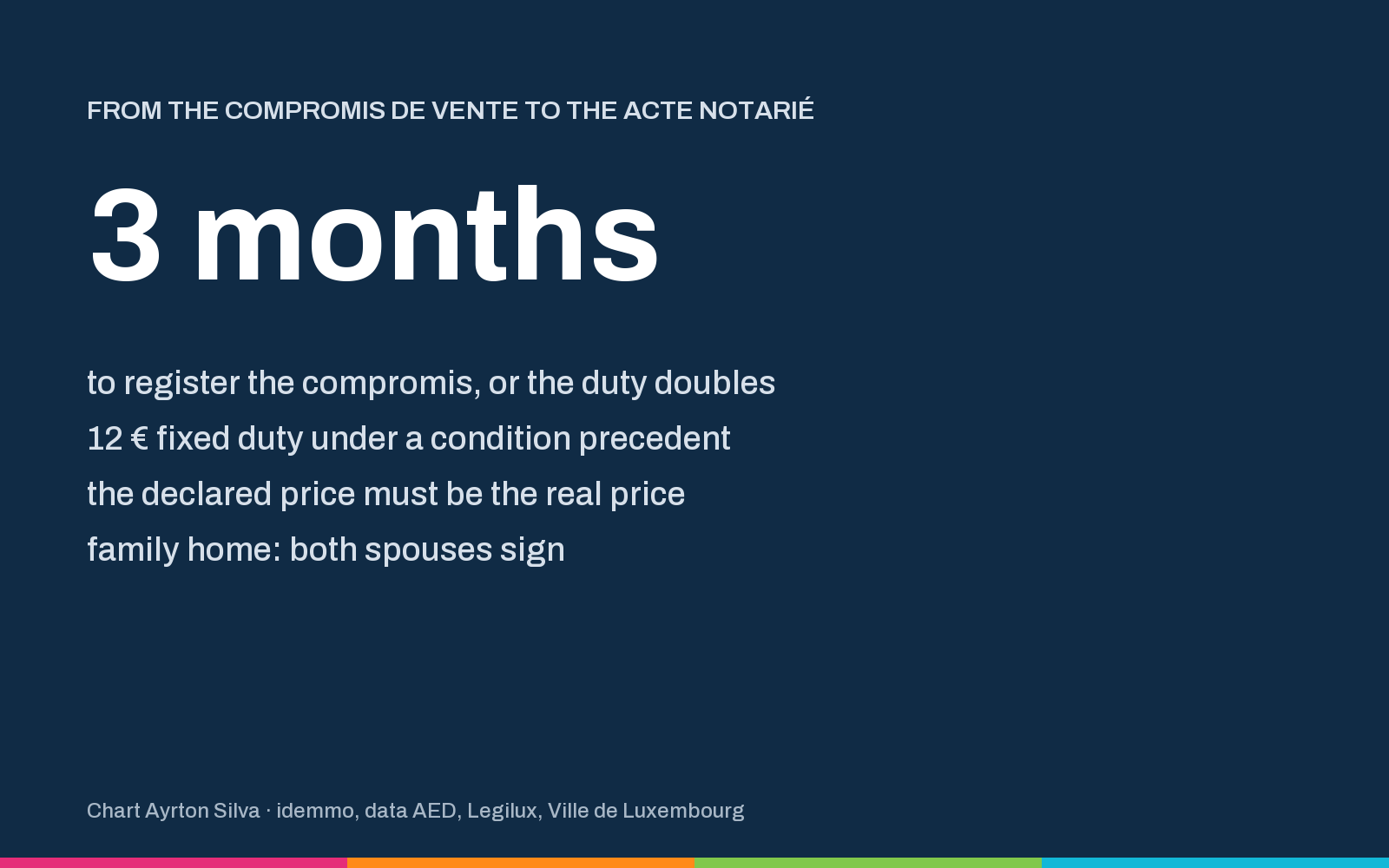
In Luxembourg, a private compromis de vente must be registered within three months, otherwise the double duty applies. While the condition precedent is not met, only a fixed duty of 12 € is due. The declared price must be the real price, and the family home can only be sold with both spouses' consent.
Luxembourg