

Guide
Selling a rented property in Luxembourg: the tenant's lease
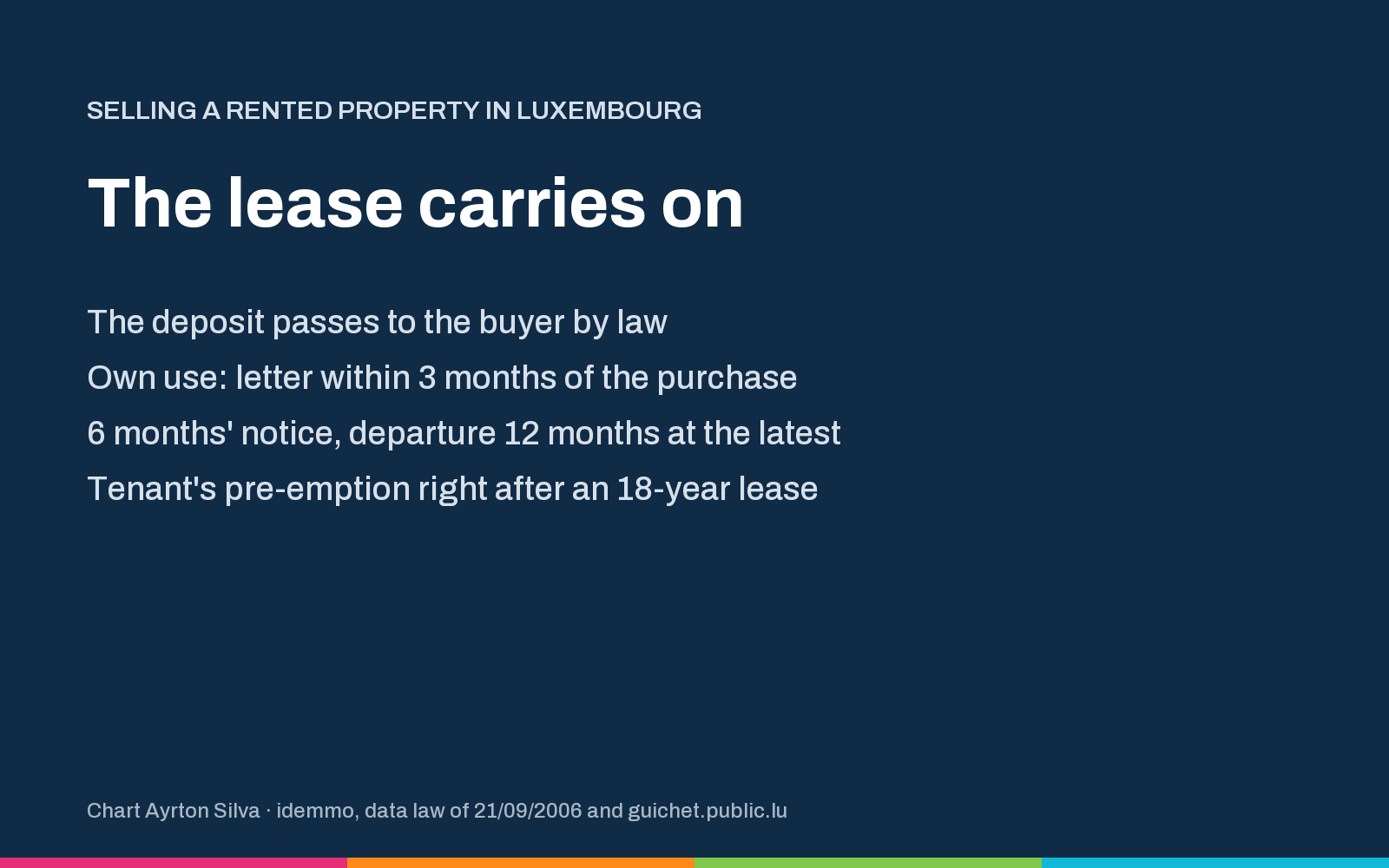
In Luxembourg, selling a rented home does not end the lease: it carries on with the buyer, and the sale is not a serious ground for making the tenant leave. The deposit passes to the new owner by law. A buyer who wants to live in the home sends a termination letter within 3 months of the purchase, with a notice period of 6 months, and the tenant leaves 12 months after the letter at the latest. After an 18-year lease, the tenant may hold a pre-emption right.
Can you sell a rented home in Luxembourg?
Yes, and the tenant stays. The amended law of 21/09/2006 on residential leases is clear on this point: the transfer of ownership of the home is not a serious and legitimate ground for ending the lease.1 The lease carries on with the buyer on the same terms: same rent, same charges, same duration.
The law goes further than the Code civil. By way of derogation from article 1743, the buyer cannot evict a tenant who occupied the home before the deed of sale, even if the lease has no certain date, unless one of the grounds set by law applies: own use, the tenant failing to meet their obligations, or another serious and legitimate ground the buyer must prove.1 Guichet.lu sums it up: the sale of a rented property transfers the lease to the new owner.2
For the seller, the consequence is simple: you are not selling a flat, you are selling a flat with its lease. The price, the target buyer and the timetable all depend on it.
What can a buyer who wants to live in the home do?
This is the question most buyers who intend to live in the property will ask. The law opens a door for them, under strict conditions.1
- Who: the buyer, or a relative by blood or marriage up to and including the 3rd degree, who will actually live in the home.
- When: the termination letter goes by registered post within 3 months of the acquisition. After that, the buyer is a landlord like any other.
- How: a written, reasoned letter, sent by registered post with acknowledgement of receipt, with the relevant documents, quoting the text of the law, failing which it is void.
- Notice: 6 months. The tenant can ask the juge de paix for an extension, but must leave 12 months after the letter was sent at the latest.
- Afterwards: the home must actually be occupied by the person named. If not, the former tenant can claim damages.1
A buyer who wants to move in should therefore count on 6 months after the letter in the shortest case, and up to 12 months in the longest case. If the purchase is financed with a loan while rent is still being paid elsewhere, that delay weighs on the budget, and so on the offer.
One point for the seller: promising a buyer a vacant home on a set date while the tenant is in place has no basis. What can be promised is a lease handed over and a complete file. The tenant's departure depends on the tenant's own decision or on the buyer's procedure.
Does the tenant have a pre-emption right?
In one specific case only. A tenant whose lease has been running for at least 18 years has a pre-emption right on the home, if they rent the whole building or if the rented flat is under the co-ownership regime.1
The procedure is framed:
- The landlord sends the tenant the offer to sell by registered letter, stating that the tenant may make a counter-proposal.
- The tenant has 1 month to reply. If the tenant has applied for a loan from a financial institution established in the Grand Duchy, the period becomes 2 months. Silence counts as refusal.
- The home can then be sold to a third party only at a price higher than the one the tenant offered.
The right does not apply to a sale by public auction, a transfer to a relative of the landlord up to the 3rd degree, or a transfer for no consideration. Ignoring it is costly: the tenant can claim damages from the seller of at least one year's rent.1
Before putting the property on the market, check the start date of the lease. If it goes back 18 years or more, the offer to the tenant comes first, before any listing.
How to organise viewings with a tenant in place?
The lease law sets no specific rule on viewings for a sale. The home remains the tenant's, who has the use of it. In practice, viewings are prepared with the tenant:
- tell the tenant about the sale before the first listing, and explain that the lease carries on;
- reread the lease: a clause may provide for viewings in case of sale, their days and their notice;
- group viewings into slots agreed in advance, rather than visits as they come;
- keep viewings for buyers whose plans have been checked: budget, financing, intention to live in or to let.
A tenant who is informed and respected makes viewings easier. Photos are taken with the tenant's agreement, without identifiable personal items.
Selling rented or vacant: who is the property for?
The two options target two different audiences.
Sold rented, the property speaks to an investor
An investor buys an income. They read three documents: the lease, the rent and the calculation of the legal cap. In Luxembourg, the annual rent cannot exceed 5 % of the revalued invested capital. The land counts at its purchase cost or, at the landlord's choice, at a flat 20 % of the invested capital. If the building is 15 years old or more, the capital excluding land is reduced by 2 % per additional two-year period, unless the landlord proves equivalent maintenance or repair spending.1
Two rules matter directly to an investor who takes over the lease:
- On a sale, the purchase price stated in the deed and the deed costs are presumed to match the revalued and reduced invested capital. This presumption can be challenged before the commission des loyers.1
- Rent can be adjusted at most every two years, by 10 % at most, and that period does not end with a change of landlord.1 The buyer therefore takes over the seller's adjustment calendar.
A rent well below the market, or a recent adjustment, shows up in the investor's offer. A rent consistent with the cap, paid regularly, with a complete file, is reassuring.
Sold vacant, it opens up to buyers who want to live there
A vacant home can be viewed freely and speaks to buyers who want to live in it. But vacating a home is not the seller's decision alone, and waiting for a fixed-term lease to end is not enough: a lease that comes to an end, for whatever reason, is extended for an indefinite term, unless there is own use, a breach by the tenant or another serious and legitimate ground.1 The tenant can leave of their own accord, with a notice period of 3 months, unless the written lease provides a longer one.2 The landlord can only terminate on one of the grounds in the law, including own use, with 6 months' notice.1
Own use means actual occupation by the landlord or a relative up to the 3rd degree. Invoking it in order to then sell the home vacant does not match what the law provides. If the home is not occupied for the stated purpose within 3 months of the tenant leaving, the former tenant is entitled to damages, of at least one year's rent if the ground was fraudulent.1
Three questions to decide
- The lease: since when, at what rent, and does the tenant plan to leave?
- The target buyer: an investor buying an income, or a household that wants to live there?
- The timetable: can the seller wait for a possible departure, or is the capital needed by a given date?
A valuation drawn up under both scenarios, rented and vacant, puts figures and timing side by side.
What to hand to the buyer of a rented property?
A complete file avoids last-minute questions at the notary. For a rented property, it includes:
- the signed lease, with any amendments;
- the move-in inventory: where a deposit was agreed, the law requires a written inventory signed by both parties no later than the day the tenant moves in;1
- the amount of the deposit, which cannot exceed 2 months' rent, and the form in which it was provided;
- the calculation of the rent against the legal cap, with the documents on the invested capital;
- the date and amount of the last rent adjustment;
- the service charge statements for recent years and the tenant's payment record;
- the CPE: it is required on a sale if the home does not already have a valid certificate, its classes appear in the listing and the original goes to the new owner;3
- the usual co-ownership documents.
The deposit follows the property: on a transfer of ownership, it passes to the new owner by law, and any agreement to the contrary only binds seller and buyer.1 In practice, the buyer is the one who will return the deposit to the tenant at the end of the lease. Seller and buyer take it into account between themselves in the compromis de vente and then the deed, which is why its exact amount should be known from the start.
Finally, inform the tenant in writing after the deed is signed: the new owner's name and the payment details for the rent from the agreed date.
To estimate the net proceeds of the sale, the net seller tool works out what is left after costs, and the investor page sets out what a buyer of a rented property looks at. If the real question is whether to keep the property and let it, see renting or selling your flat, and for the energy certificate, CPE and selling.
Sources
- Loi modifiée du 21/09/2006 sur le bail à usage d'habitation, texte coordonné · Ministère du Logement · 15/11/2026
- Résilier ou céder un contrat de bail de location · guichet.public.lu · 15/11/2026
- Faire établir un certificat de performance énergétique (Energiepass) pour un bâtiment d'habitation · guichet.public.lu · 15/11/2026
Every figure in the article points to a public source, cited with its date. Sources are in French.
Frequently asked questions
Can the new owner give the tenant notice after the sale?
The sale alone is not enough. If the buyer wants to live in the home, or house a relative by blood or marriage up to the 3rd degree, a reasoned registered letter goes out within 3 months of the purchase. The notice period is 6 months and the tenant leaves 12 months after the letter at the latest.
What happens to the tenant's deposit when I sell?
It passes to the new owner by law, who will return it at the end of the lease. Seller and buyer settle the amount between themselves in the compromis and then the deed.
Does my tenant have a pre-emption right?
Only if the lease has been running for at least 18 years and the tenant rents the whole building or a flat under co-ownership. The property must then be offered to the tenant first, by registered letter, and the tenant has one month to reply.
Is it better to sell rented or vacant?
It depends on the buyer you are aiming for. Rented, the property speaks to an investor, who reads the rent, the lease and the legal cap. Vacant, it opens up to buyers who want to live there. A valuation under both scenarios helps decide.
Request my written valuation
Property address, commune, a word about your plans: Ayrton calls you back.
Prefer a message? One word is enough.
Send ESTIMATION on WhatsAppRead next
Purchase offer in Luxembourg: what the seller checks
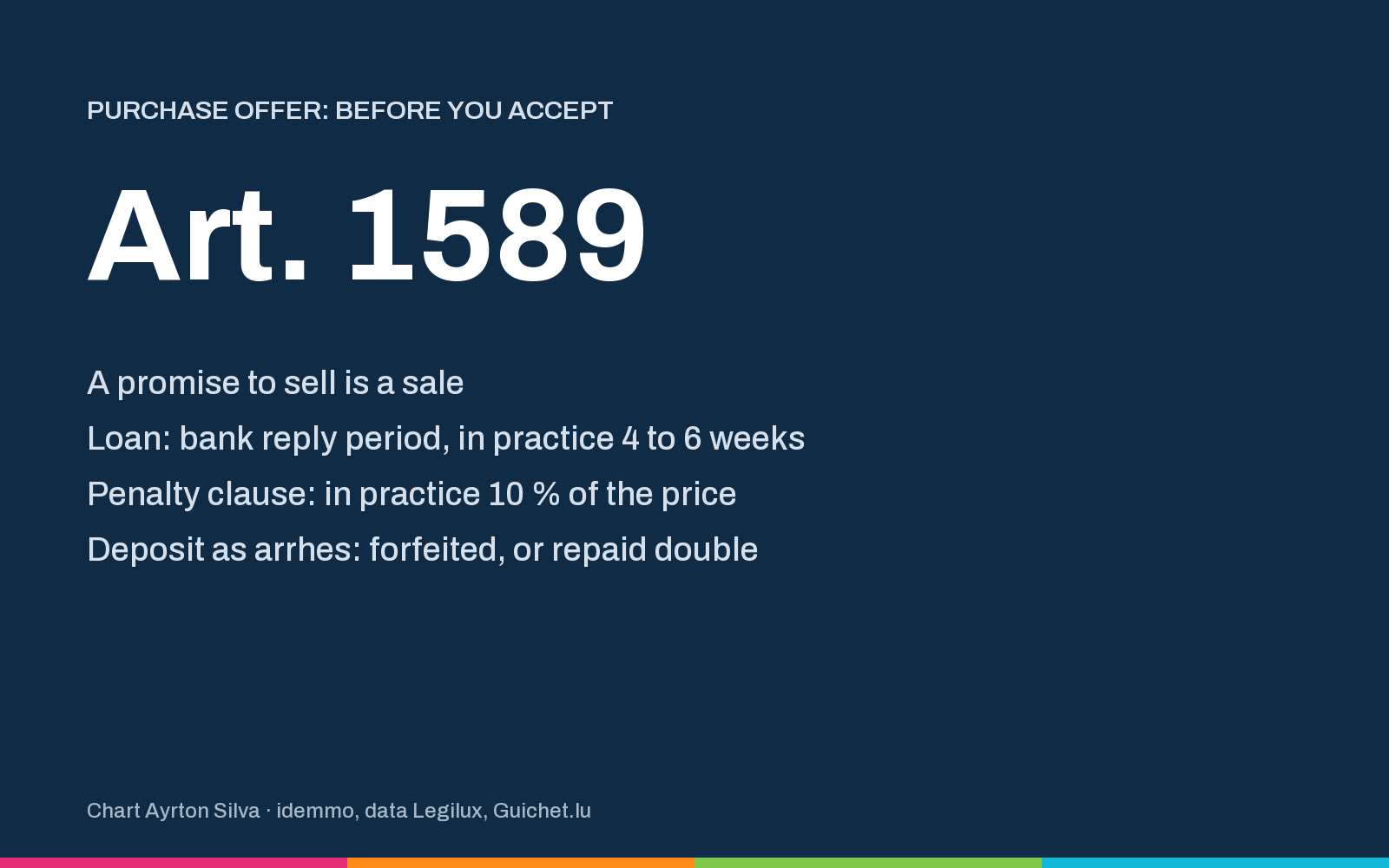
In Luxembourg, a sale is complete as soon as seller and buyer agree on the property and on the price (Civil Code, art. 1583). Accepting an offer in writing can therefore already bind you. Before signing, read the loan condition and its deadline, the nature of any sum paid and the planned date of the deed.
Documents to sell a property in Luxembourg: the checklist
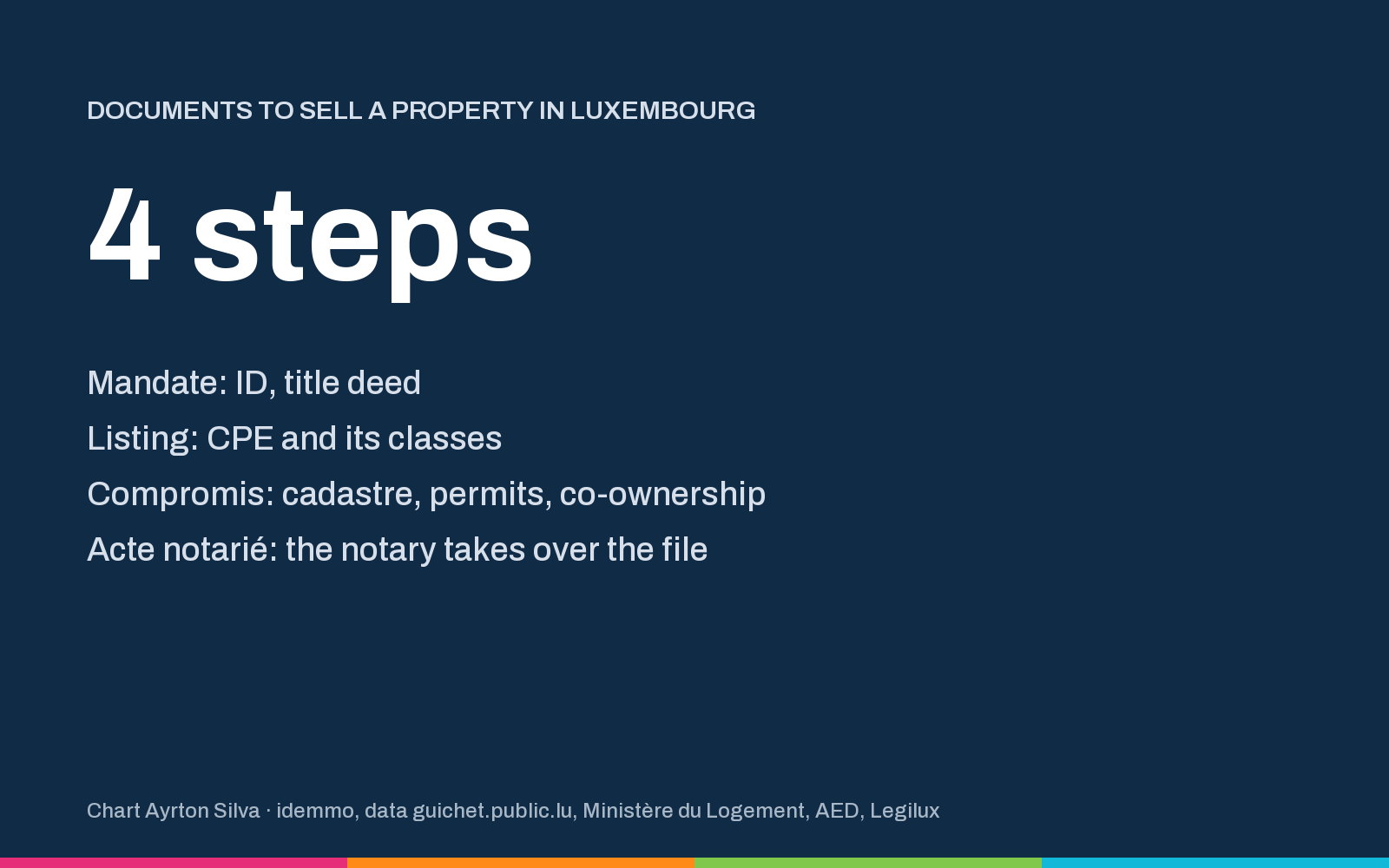
A sale in Luxembourg runs through four steps: the mandate, the listing, the compromis de vente and the acte notarié. The CPE, valid for 10 years, must exist before the listing, which shows its classes. The title deed, the cadastral extract, the building permits and, in a co-ownership, the tableau descriptif de division and the balance of the works fund are gathered before the compromis.
Selling an inherited property in Luxembourg: capital gains
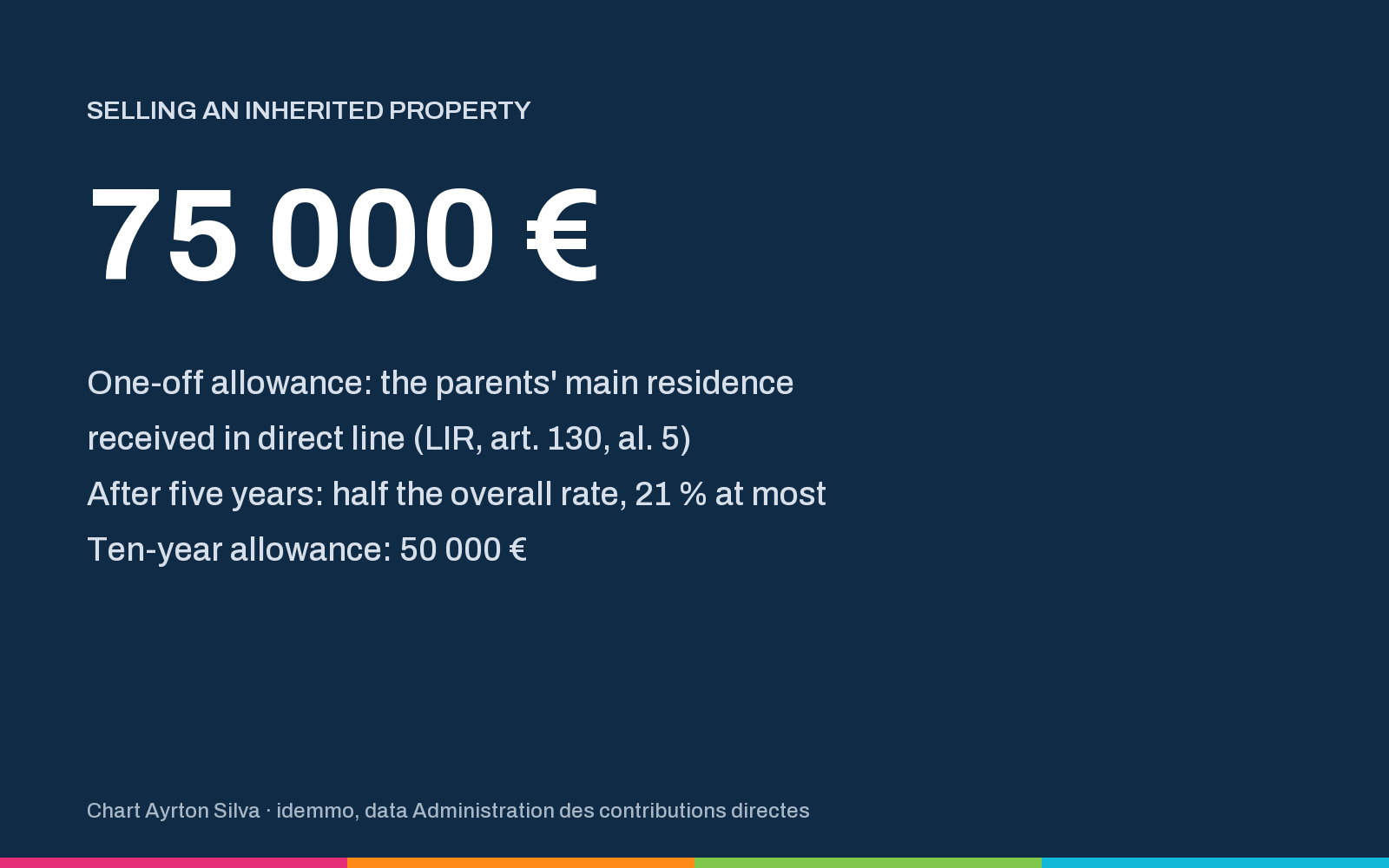
Selling a property received through an inheritance in Luxembourg can trigger tax on the gain. Beyond five years, the disposal gain is taxed at half the global rate, 21 % at most, with an allowance of 50 000 € over ten years and, once only, 75 000 € for the parents' main residence received in direct line. In joint ownership, the sale of the whole property is decided with all the heirs.