

Guide
How a property valuation is worked out in Luxembourg
A sound valuation starts from sale prices recorded before the notary, not from listings. For apartments, the Observatoire de l'Habitat publishes these prices by commune: 6 427 €/m² in Esch-sur-Alzette over 239 sales, 07/2025 to 06/2026. For houses, it publishes only asking prices by commune. Then comparables are chosen, adjusted (surface, floor, outdoor space, parking, condition, energy class), cross-checked against rent or cost, and the result is written as a range.
The short answer
A valuation is built in four steps. It starts from the sale prices recorded before the notary in the commune. Comparable properties are chosen. The differences between those comparables and your property are adjusted. The result is cross-checked by a second method, then written as a range, with its sources.
What follows details each step, with the official figures published in Luxembourg and what they do, or do not, allow you to conclude.
Recorded prices and asking prices: two different measures
Two public series circulate, and they do not measure the same thing.
Recorded prices come from notarial deeds, passed on by the Publicité foncière and calculated by STATEC and the Observatoire de l'Habitat. They are what buyers actually paid. On transactions from 01/07/2025 to 30/06/2026, an existing apartment sold for 7 712 €/m² on average across the country, and an apartment under construction for 9 839 €/m².3
Asking prices come from property listings. The Observatoire also publishes them by commune, stating that they are in no way the prices actually paid by buyers, but the prices asked when the property goes on sale.2 Between the listing and the deed come viewings, negotiation and sometimes a price cut. The public data give no average figure for the gap between the two series: this page does not invent one.
A valuation based on the neighbourhood's listings therefore measures other sellers' ambitions, not the market. It tells you about the competition when you list, not what the property is worth.
Apartments: a commune average, taken from deeds
For apartments, the Observatoire publishes the average recorded sale price commune by commune, with the number of sales in the period.1
| Commune | Recorded sales | Average per m² | Period |
|---|---|---|---|
| Esch-sur-Alzette | 239 sales | 6 427 €/m² | 07/2025 to 06/2026 |
| Luxembourg | 613 sales | 10 269 €/m² | 07/2025 to 06/2026 |
Two cautions when reading it. First, a commune shows an average only from a minimum number of apartment sales in the period, after extreme values are removed: 10 transactions in the commune dataset,1 5 on the Logement en chiffres map.3 In a small commune the average may therefore be missing, or rest on few deeds. Second, the average mixes very different properties: studios and large apartments, ground floors and top floors, renovated units and units to redo. It gives the commune's order of magnitude, not the price of your apartment.
Houses: why there is no sale price by commune
For houses, the Observatoire does not publish recorded sale prices by commune. It publishes, commune by commune, asking prices: 5 092 €/m² in Esch-sur-Alzette, over 405 listings, for 07/2025 to 06/2026.2 That is a price asked, never a sale price.
Signed prices exist, but at the level of the country and its broad regions, and as total prices. On transactions from 01/07/2025 to 30/06/2026, a house sold for 945 274 € on average across the country, with a median price of 870 000 €.3 The median, lower than the average, shows that a few very expensive sales pull the average up. The gap between regions is clear: in the canton of Esch-sur-Alzette the average is 803 815 € and the median 740 000 €; in the canton of Luxembourg, 1 372 796 € and 1 300 000 €.3
The Observatoire does not explain this choice, but the nature of houses largely accounts for it. Two houses with the same living area can have plots of very different sizes, be detached or terraced, and be built forty years apart. A commune average per m² would mean little. For a house, the valuation rests more on known comparable sales and on an analysis of the plot and the building.
Comparables: the core of the method
A comparable is a recent sale of a property close to yours: same commune and, where possible, same neighbourhood, same type, similar surface, recent period. Three to six good references are worth more than a broad average.
The sales published by the Observatoire set the frame. The precise comparables come from known sales in the area: recent deeds, sales followed by the agent, similar properties sold in the street or the building. An older reference is corrected for the market's movement since its date, and an atypical sale (between family members, a property in very poor condition, a rushed sale) is set aside.
Adjustments: what makes the gap with the average
STATEC calculates its price indices "at constant quality", that is, neutralising the characteristics of the properties sold. For apartments, it uses the surface, new or existing, the cellar, the garage or parking space, and the travel time to Luxembourg City. For existing houses: the surface and the plot size, detached or semi-detached, the number of rooms and bathrooms, the year of construction, covered parking spaces, major works and travel time.3 These are the same levers a valuation adjusts one by one.
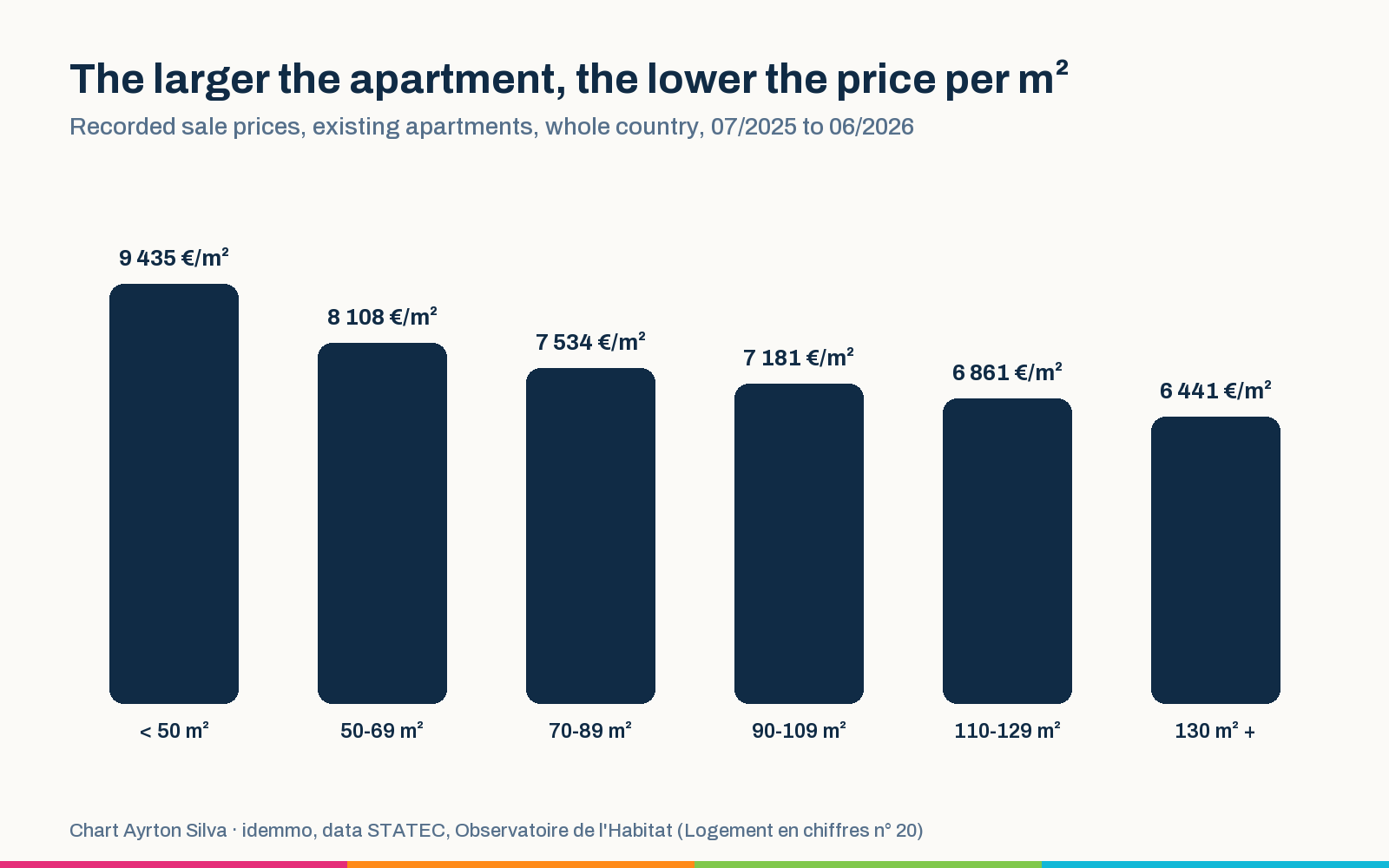
Surface works the opposite way to what many expect: the larger the apartment, the lower its price per m².3
| Surface (existing apartments) | Average recorded price |
|---|---|
| Under 50 m² | 9 435 €/m² |
| 50 to 69 m² | 8 108 €/m² |
| 70 to 89 m² | 7 534 €/m² |
| 90 to 109 m² | 7 181 €/m² |
| 110 to 129 m² | 6 861 €/m² |
| 130 m² and over | 6 441 €/m² |
National averages, transactions from 01/07/2025 to 30/06/2026.3 Applying to a large apartment the average of a commune dominated by small units overstates its value, and the reverse.
New build also carries a price: an apartment under construction is 23 % to 29 % more expensive than an existing one of comparable surface.3 A recent building is therefore compared with recent sales of the same generation.
The other adjustments are weighed property by property:
- Floor and lift: a high floor without a lift weighs on value, a top floor with a lift and a view supports it.
- Outdoor space: balcony, terrace or private garden, according to size and orientation.
- Parking: closed garage or parking space, included or sold separately.
- Condition: work to be done, costed, rather than a flat discount.
- Energy class: the energy performance certificate is compulsory for a sale, valid for 10 years, and rates the home from A+ to I.4 A sale listing must show the energy performance class and the thermal insulation class. A class F to I does not block a sale, but the buyer builds the cost of works into the offer.
The public data publish no official percentage per criterion (floor, terrace, energy class): each adjustment is justified by comparable sales, not by a fixed rule.
Three methods, and why they are cross-checked
Comparison is the main method for a home: prices of comparable sales, adjusted. It works whenever reference sales exist.
Income (rent capitalisation) starts from the rent the property can produce, divided by the yield investors expect. It serves for a let property, a block of flats or an investor. It is read with care: in the 2nd quarter of 2026, asking rents for apartments rose by 5,8 % over one year, against 1,3 % for rents in existing leases.3 An asking rent is not the rent of a lease in place.
Cost adds the value of the land to the cost of rebuilding the building, less its wear. It serves for an atypical house, a building plot or a property without comparables. Construction cost is dated with the STATEC index: 1 195,69 points in April 2026 (base 1970 = 100), up 2,6 % over one year.5
When two methods give close results, the range narrows. When they diverge, the gap says something: a rent too low, an undervalued plot, a property the local market does not value at its cost.
Why online estimators do not give the same figure
Online tools apply an average to a surface. They differ because they do not start from the same data: some use listings, others deeds, over different periods and areas. None of them visits the property. They ignore condition, light, view, nuisances, the co-ownership and the works already voted.
They remain useful to place an order of magnitude. This site's price per m² tool applies your commune's official average to your surface, always stating the nature of the figure, recorded or asking, and its period.
A range, not a single figure
An honest valuation is presented as a range. Its width depends on the number and quality of comparables: narrow for an apartment in a building where several units sold recently, wider for an atypical house or a commune where sales are rare. The recommended listing price sits within that range, according to the time you give yourself and the competition online when you list.
No valuation sets the sale price: the buyer sets it, on the day of signing.
What a written valuation contains
A serious written valuation fits on a few pages and can be read without the agent:
- The description of the property: surface, floor, outdoor space, parking, condition, energy class, documents seen.
- The market sources, each with its organisation, period and nature: recorded sale or asking price.
- The comparables used, with date, surface and price, and those set aside with the reason.
- The adjustments, costed one by one.
- The method or methods used, and how they cross-check.
- The value range and the recommended listing price.
- The reservations: date of the valuation, missing documents, points to check (co-ownership, planning, easements).
For a written valuation of your property, start from the page that fits it: selling an apartment or selling a house.
Sources
- Prix de vente enregistrés des appartements par commune · Observatoire de l'Habitat (LISER / Ministère du Logement) · 15/11/2026
- Prix annoncés des logements par commune · Observatoire de l'Habitat (LISER / Ministère du Logement) · 15/11/2026
- Le Logement en chiffres n° 20 (septembre 2026) · STATEC, Observatoire de l'Habitat (LISER), données Publicité foncière · 15/11/2026
- Certificat de performance énergétique (passeport énergétique) : demande · guichet.public.lu · 15/11/2026
- Une accélération marquée des prix de la construction résidentielle · STATEC · 15/11/2026
Every figure in the article points to a public source, cited with its date. Sources are in French.
Frequently asked questions
What is the difference between an asking price and a recorded price?
The asking price is what the seller asks for in the listing, before any negotiation. The recorded price is the one in the notarial deed, passed on by the Publicité foncière. The Observatoire de l'Habitat states that its asking prices are in no way prices actually paid.
Why are there no house sale prices by commune?
The Observatoire de l'Habitat publishes recorded sale prices by commune for apartments. For houses, it publishes asking prices by commune, and signed prices only by broad region, as total prices. One explanation lies in the houses themselves: plot, building type and age vary too much for a commune average per m² to mean much.
Why do online estimators give different figures?
Because they do not start from the same data (listings or deeds), the same period or the same area, and they do not see the property: not its condition, its floor, its view or the work it needs. They give an order of magnitude, not a value.
What does a written valuation contain?
A description of the property, dated market sources and their nature, the comparables used, the adjustments in figures, the method or methods applied, a range with a recommended listing price, and the reservations: documents seen, documents missing, date of the valuation.
Valuation or expert report: which one do I need?
A valuation is used to set a listing price and prepare the negotiation. An expert report is drawn up by a valuer, often requested when a third party has to rely on the value: a bank, a division of assets, an estate or a dispute. Before ordering either, ask whoever requires the document which form they accept.
Communes mentioned
-
Esch-sur-Alzette
Apartments, recorded 6 427 €/m²
-
Luxembourg
Apartments, recorded 10 269 €/m²
Request my written valuation
Property address, commune, a word about your plans: Ayrton calls you back.
Prefer a message? One word is enough.
Send ESTIMATION on WhatsAppRead next
Rent out or sell your apartment in Luxembourg in 2026?
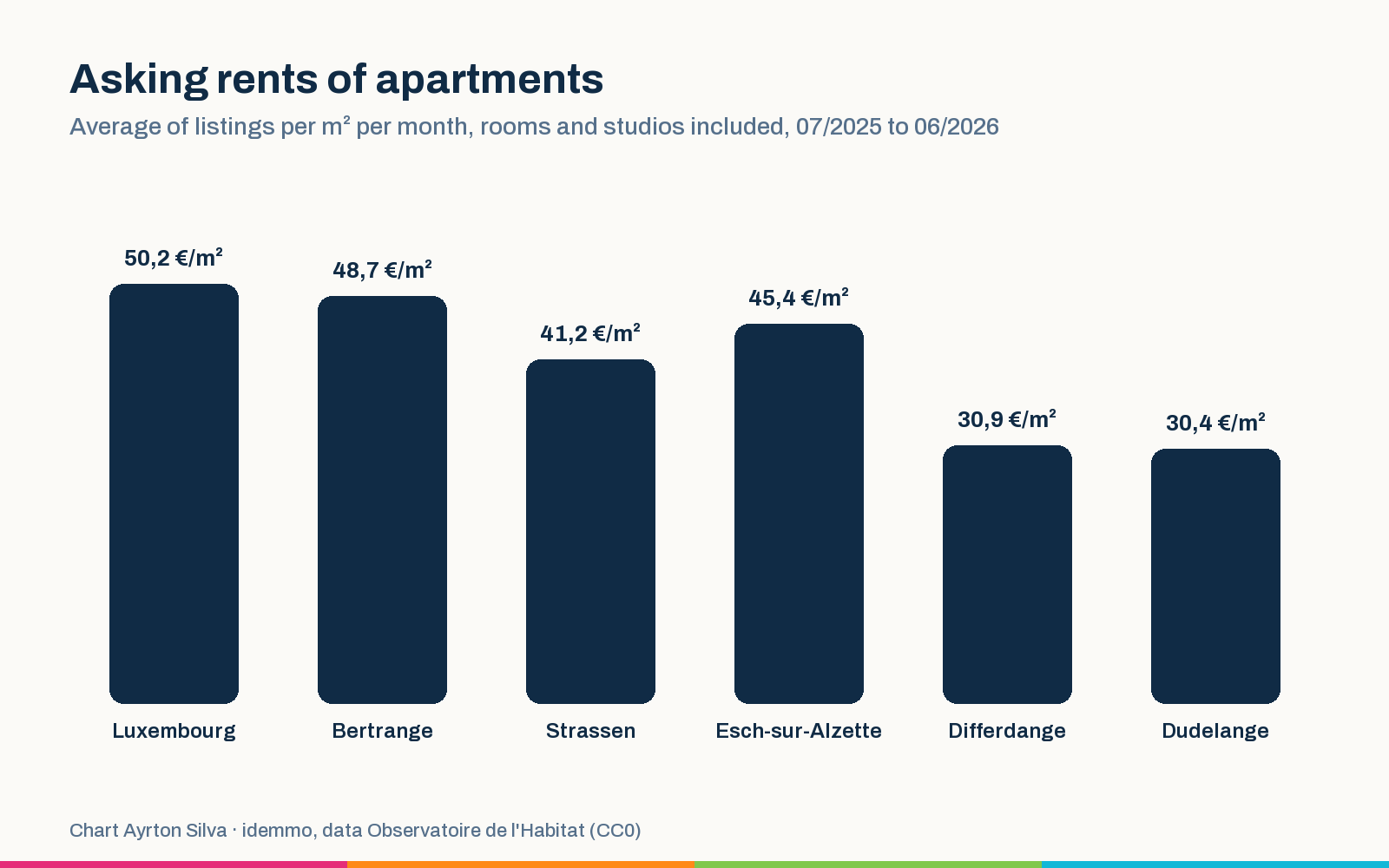
Renting out an apartment in Luxembourg means accepting a rent capped at 5 % a year of the revalued capital invested, a deposit of 2 months at most and an agency fee split 50/50. Over 07/2025 to 06/2026, asking rents and recorded sale prices in six communes are two separate reference points: dividing one by the other does not give a reliable yield. Selling frees the capital; renting keeps it, with its costs and its rules.
Luxembourg · Bertrange · Strassen · Esch-sur-Alzette · Differdange · Dudelange
From compromis de vente to acte notarié: deadlines and costs
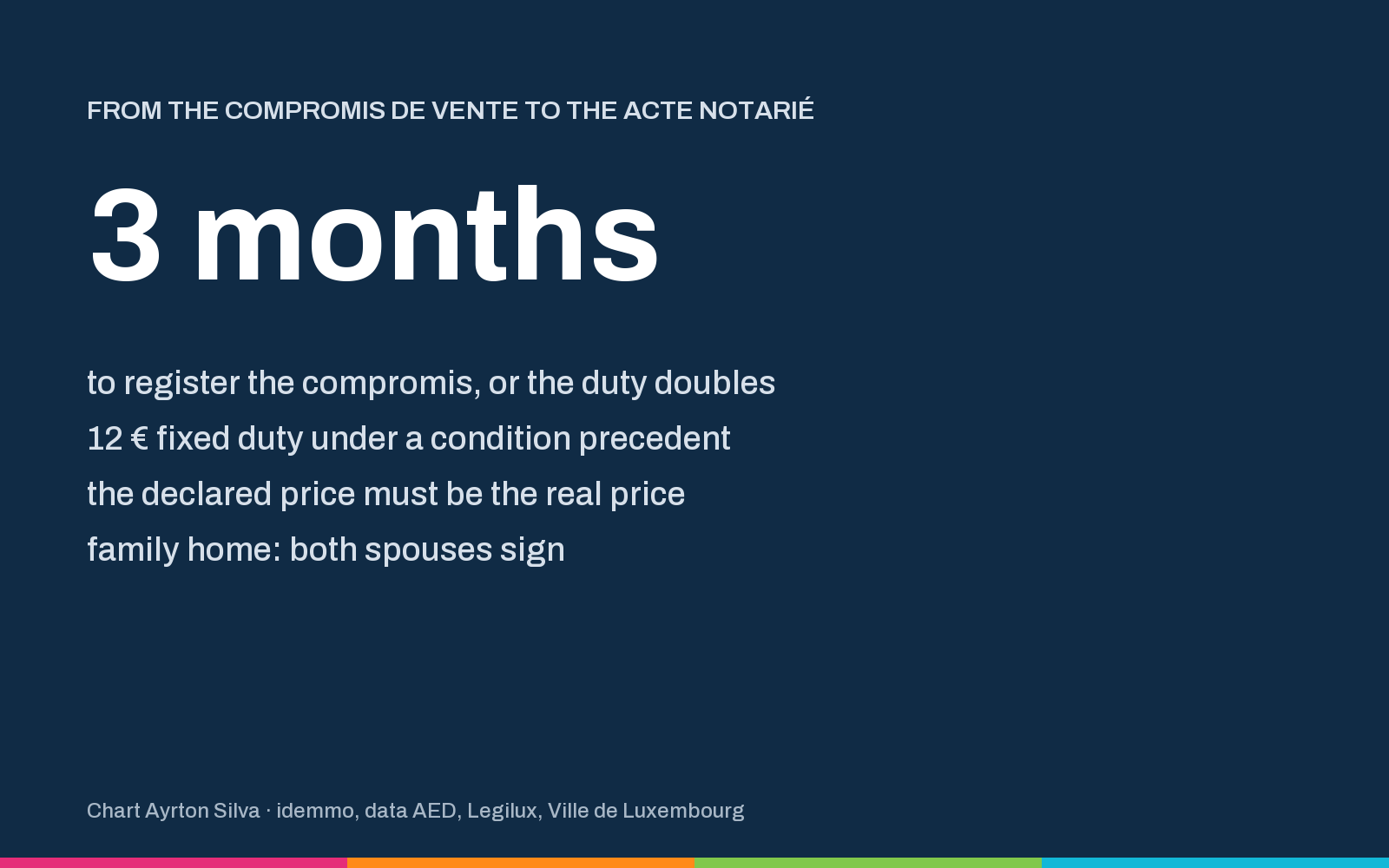
In Luxembourg, a private compromis de vente must be registered within three months, otherwise the double duty applies. While the condition precedent is not met, only a fixed duty of 12 € is due. The declared price must be the real price, and the family home can only be sold with both spouses' consent.
Luxembourg
House prices in Luxembourg: asking prices and signed prices
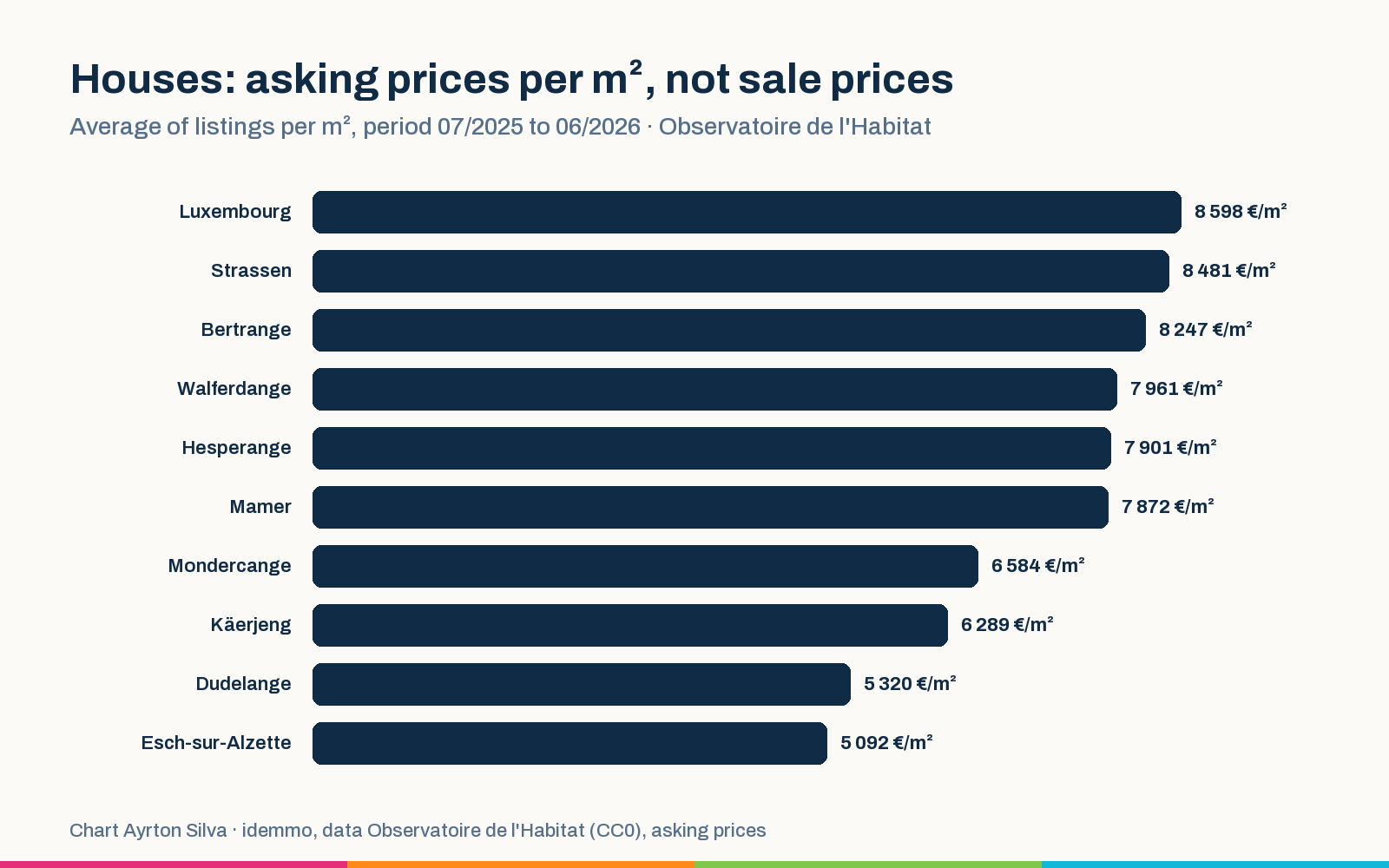
For houses, the Observatoire publishes asking prices per commune, not sale prices: from 5 092 €/m² to 8 598 €/m² in the communes compared here, over 07/2025 to 06/2026. Signed sales exist by region and as total prices: 974 194 € on average for a house sold in 2025 across the country.
Luxembourg · Strassen · Bertrange · Walferdange · Hesperange · Mamer · Mondercange · Käerjeng · Dudelange · Esch-sur-Alzette